








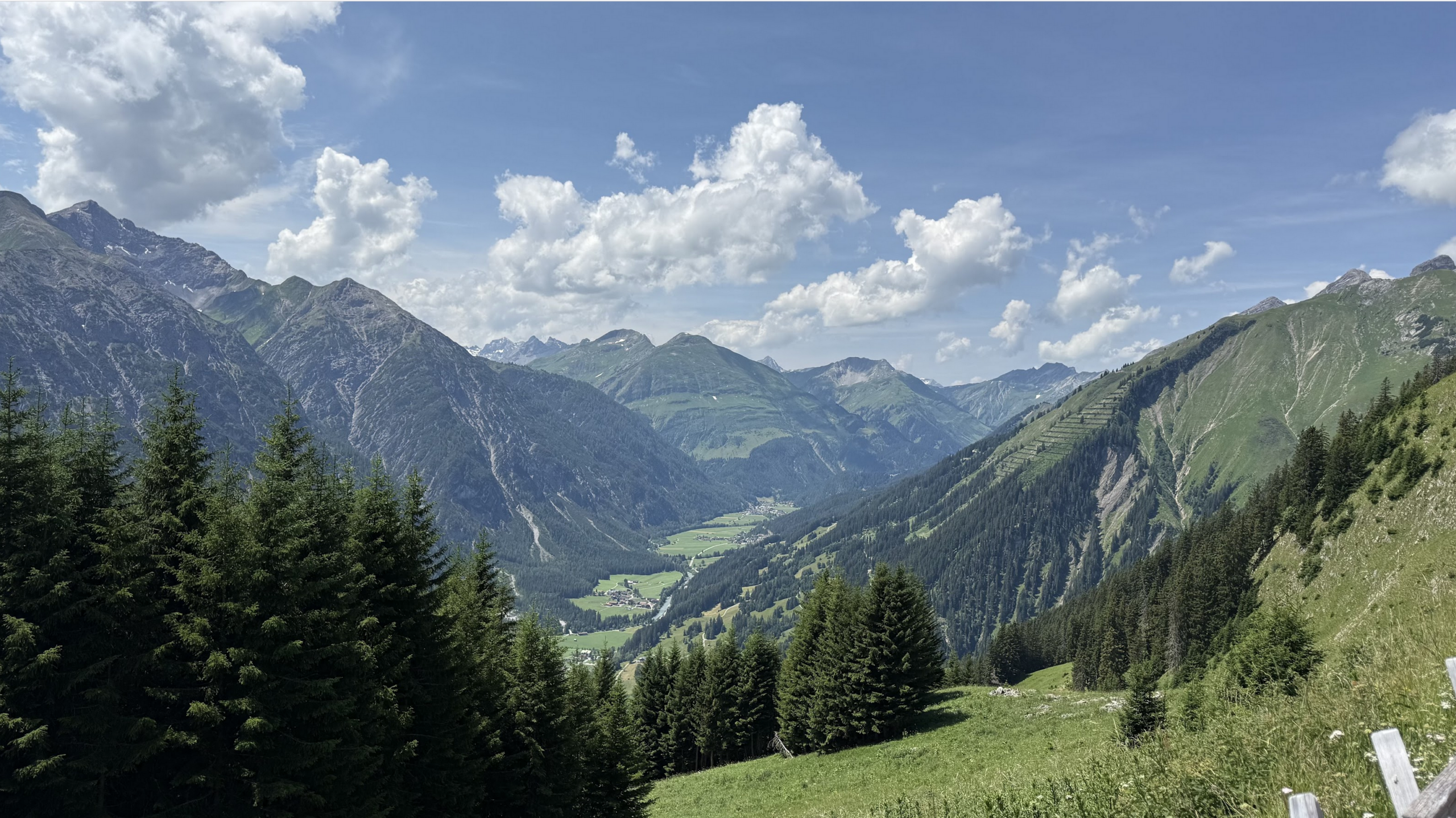

Women-only travel is booming, and a growing number of women are looking for more than a holiday. In this edition of my “Women who inspire the world” newsletter I am giving you a personal account of my recent walk along the Lechweg between Austria and Germany with a group of women.
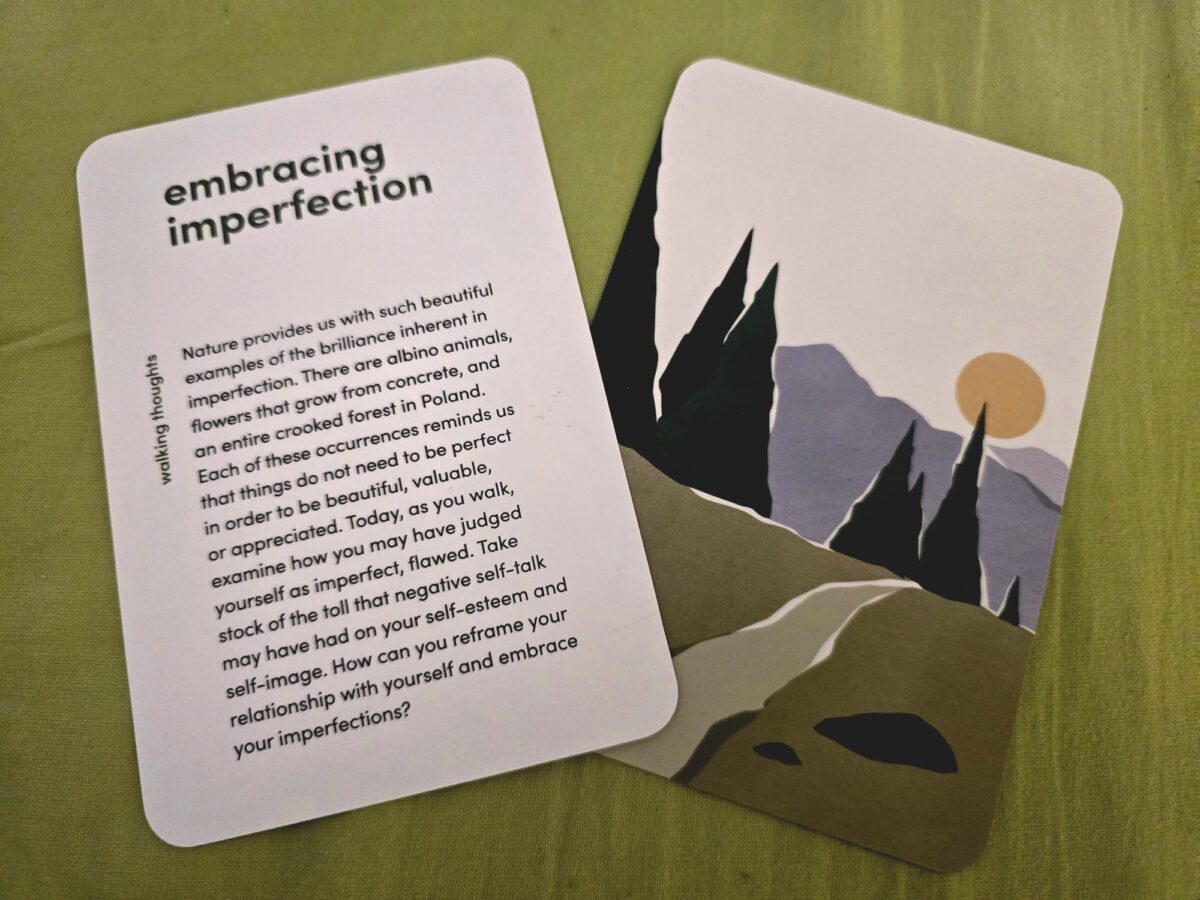
The rain has not stopped for five hours. Somewhere on the Lechweg, between one Tyrolean village and the next, a small group of women walks on, soaked to the skin, boots full of water, a first blister announcing itself. We have long since lost track of time; only the church tower of the next village reminds us of the hour. That morning, drawing a card from a meditation set as we do each day of this walk, we had landed on the theme of imperfection. The mountains, it seems, have decided to take the assignment literally.
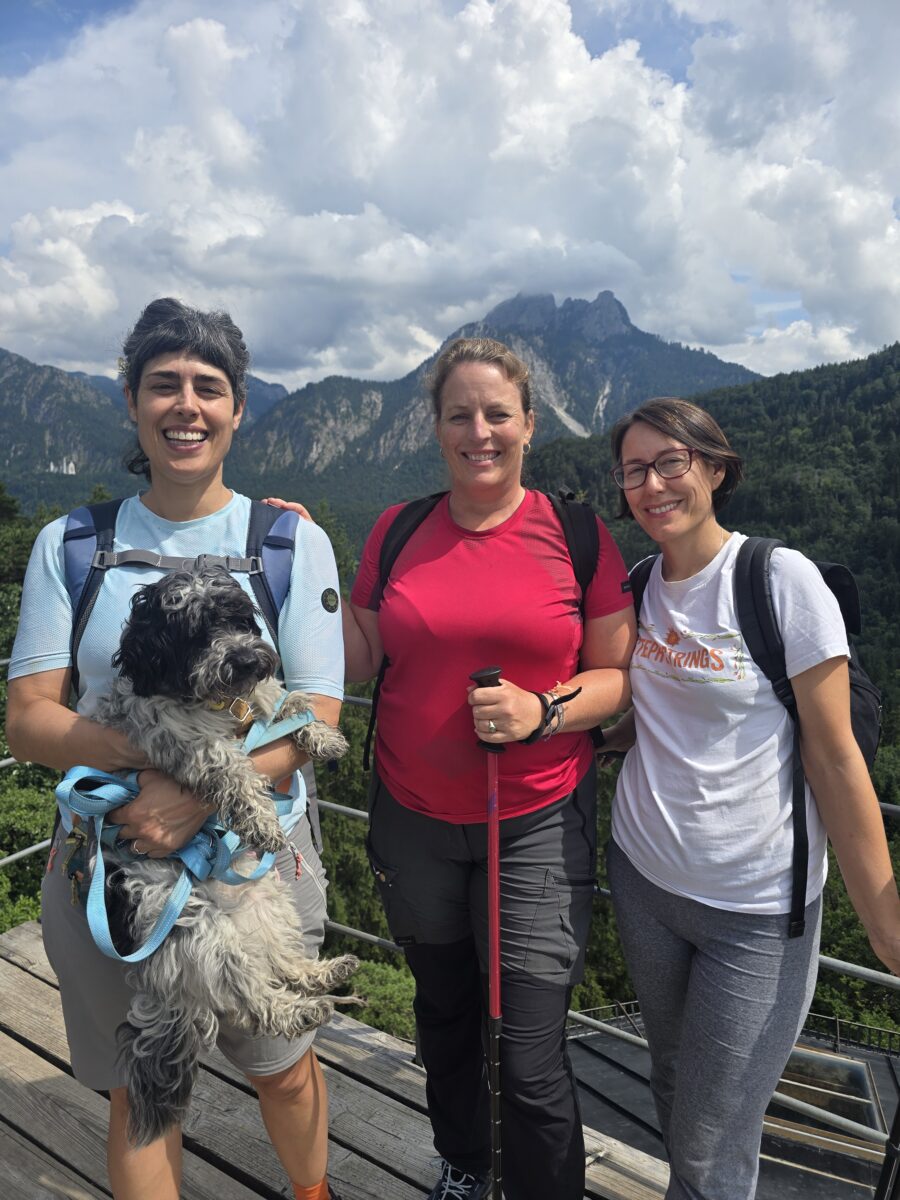
This was not a holiday in the conventional sense. It was the pilot of a coaching hike for women that I organised in the last week of June: six days on foot through the Alps, following the river Lech from Austria into Germany, combining long-distance walking with daily reflection and relaxation.
The new zeitgeist, not a niche
When I announced the walk on LinkedIn at the beginning of the year, under the headline “I will no longer postpone my dreams”, more than twenty women from around the world got in touch within days. Most could not join at such short notice, but nearly all asked to be kept posted for the next edition. The resonance came above all from women in leadership or in the so-called sandwich years: women who care for children or elderly parents, who are running businesses or holding international families together, who are permanently reachable and rarely off duty. Women for whom self-care had quietly shrunk to a couple of yoga classes a month, if at all. And women for whom something isstirring inside: some are starting what could almost be called a second life, leaving jobs, founding new businesses, or digging out a hobby that lay buried for decades.
The numbers suggest they are far from alone. Intrepid Travel, one of the largest operators in the field, reported a 59 per cent year-on-year increase in bookings for its women-only expeditions in 2024, and Google searches for travel companies for solo female travellers rose sixfold between 2020 and 2025 (Source: National Geographic Traveller, August 2025). . What was a niche a decade ago has become the new zeitgeist, and it is driven less by the wish to see new places than by the wish to connect with other women and oneself.
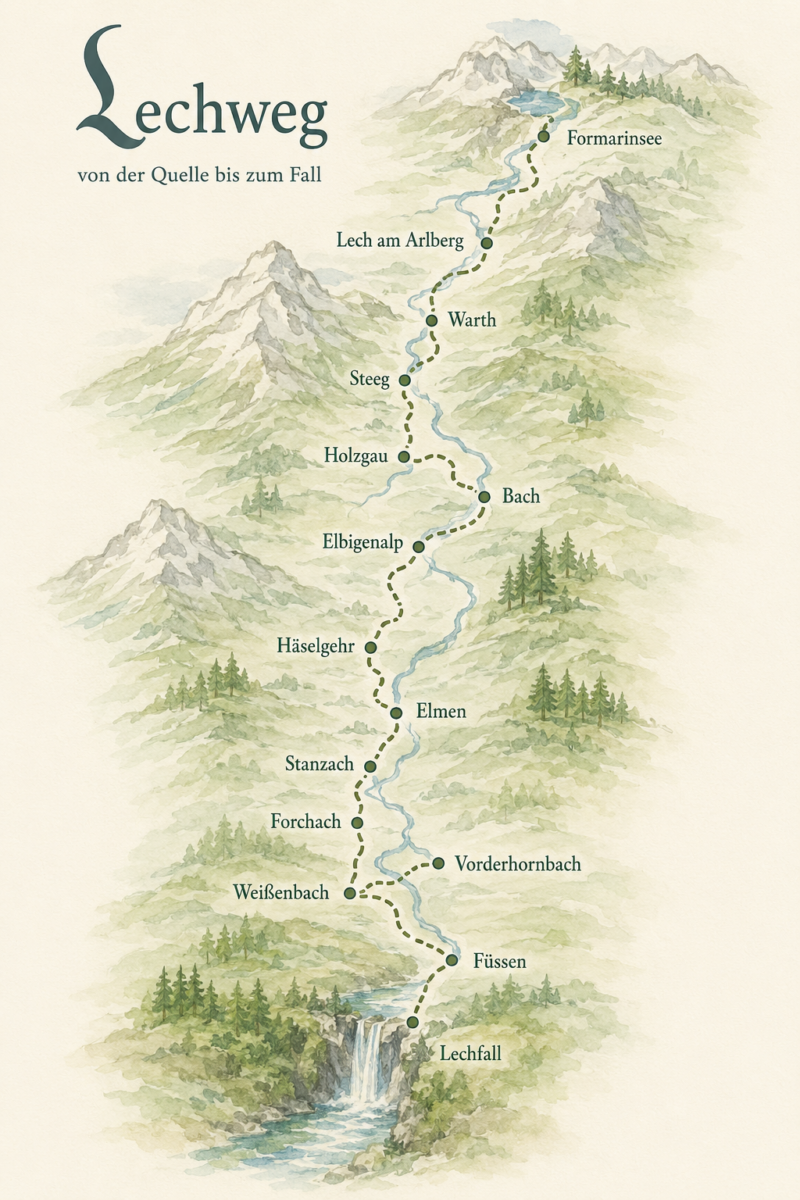
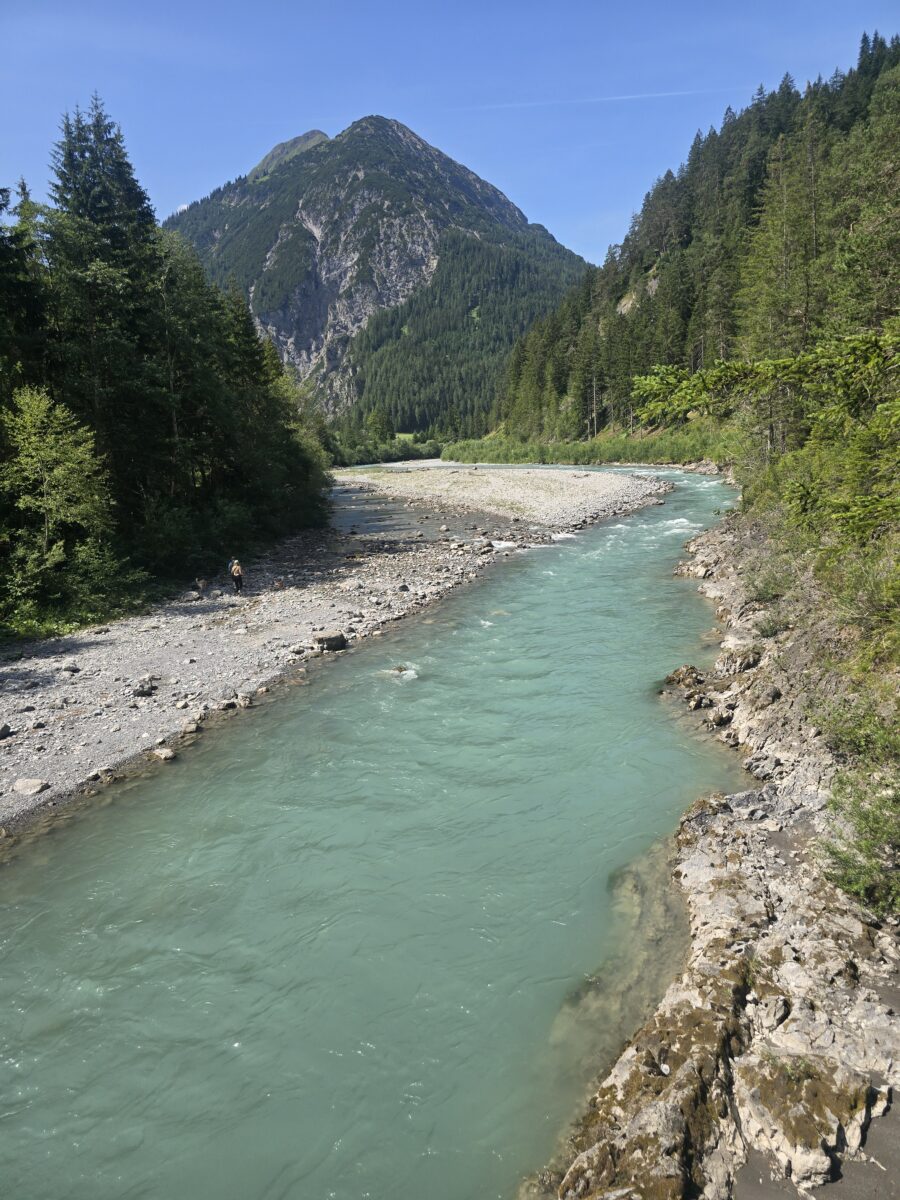
For a first edition, the Lechweg was an obvious candidate. The long-distance trail, opened in 2012, follows the river Lech for around 125 kilometres from its source near the Formarinsee in Austria to the Lechfall waterfall in Füssen, Bavaria, and was the first cross-border route to be certified as a Leading Quality Trail by the European Hiking Federation. It runs through one of the last wild river landscapes in Europe. We walked its lower half over six days, from Steeg through Elbigenalp, Stanzach and Höfen to Füssen, staying somewhere new every night while our luggage travelled ahead by shuttle. Each stage has its own character: the upper sections still feel properly alpine, then comes a day of small waterfalls and streams, then wide meadows, birdwatching and long stretches directly beside the turquoise water, and finally forest paths and lakes, with King Ludwig’s castles appearing in the distance.
The river itself carries a story worth telling. Like most alpine rivers, the Lech was straightened and constrained over the past two centuries, partly in response to the floods that repeatedly devastated the valley. Along the trail, information boards document the work now being done to undo some of that damage. Two EU-funded LIFE projects have been restoring the Tyrolean Lech since 2001, removing bank reinforcements, widening the riverbed and returning significant space to the water, an approach that improves flood protection and brings back habitats for endangered species at the same time (European Commission LIFE programme, project LIFE15 NAT/AT/000167). It is hard to walk beside a river being taught to be wild again and not draw a conclusion or two about one’s own life.
A card a day
The coaching element of the week was deliberately light. I had prepared no fixed programme, trusting instead that the right questions would surface. Each morning we drew a card from a meditation set and paired it with other questions that accompanied us on the trail. I could not have scripted what happened next: the cards and questions arranged themselves into a narrative more coherent than anything I could have planned.
Day one was about mindfulness, about seeing the beauty in the small details along the way. The question we carried was uncomfortable in the best sense: which projects or people should you let go of because they block your energy, and what do you want to leave behind on this journey? Each of us had an answer we had been avoiding. The day rewarded us generously, with a gondola ride up the Jochspitze, a spectacular view over the valley and a cold lemonade at the top. It also had a certain irony in store: in the heat, we wished out loud that we could dip our feet in water.
The Universe listened, and answered in its own way: on day two, it rained without stopping. Our feet spent the entire morning in water, inside our boots. We had briefly flirted with a late checkout, another round in the sauna and a comfortable bus ride to the next village, and decided instead to face the discomfort and see what it would do to us. After two thirds of the route, with our limits reached, we took the bus for a shortcut, and it felt like a rescue rather than a defeat: a hot shower, a pot of tea, and the deep satisfaction of a fully lived day. Keep going had become the motto of the morning; nonetheless, knowing when to stop became the lesson of the afternoon.
Day three greeted us with sun and the theme of rebirth and losing direction. Fittingly, it was the day we repeatedly wandered off the path, not on purpose, and the card we drew spoke of detours and trusting the process. It was also the day of a small paradise: we found a bathing lake with hardly anyone around, where we swam and felt gloriously free, and quiet spots along the river where we cooled our feet in proper Kneipp style. In the evening we watched Spain beat Austria three nil in the World Cup, although public viewing proved a challenge in a village of four hundred souls, so we cheered from the hotel.
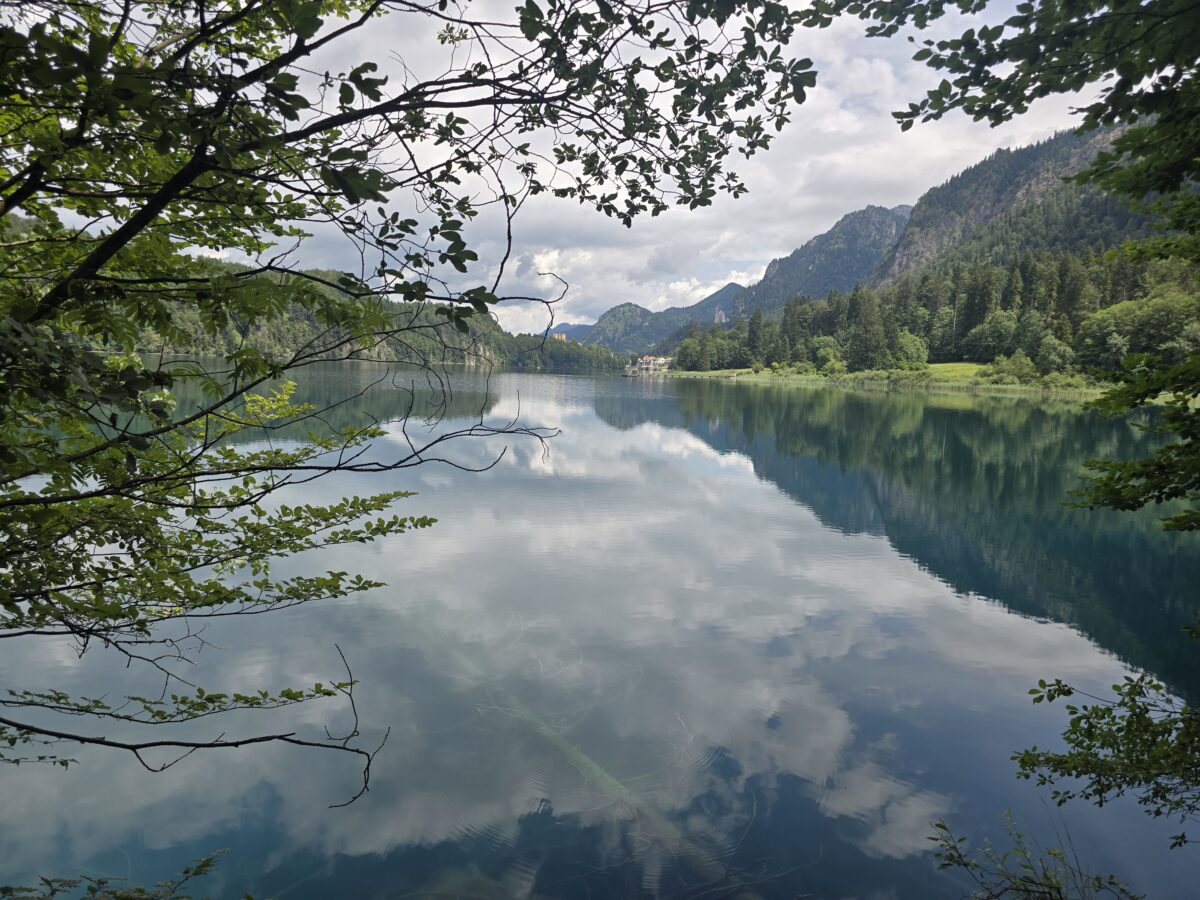
The final walking day carried the theme of growth and learning to accept one’s shadows, and it tested our planning rather than our psyches: we discovered we had miscalculated the final stage, 25 kilometres with serious climbs instead of the 16 we had expected. Rather than heroically overreaching, we used the flexibility the Lechweg offers, shortened the route with the local shuttle to Pflach, and arrived in Füssen on our own two feet, walking along the beautiful Alpsee before finally reaching the Lechfall cascade, the final destination of our tour.
What walking does to us
The intuition that a week like this resets something is increasingly backed by research. A large study of nearly 20,000 people in England found that those who spent at least two hours a week in nature were significantly more likely to report good health and wellbeing than those who spent none (White et al., Scientific Reports, 2019). Researchers at Stanford showed that a walk in a natural environment measurably reduces rumination, the repetitive negative thinking that feeds anxiety and low mood, compared with the same walk in an urban setting (Bratman et al., PNAS, 2015). Philosophy got there first, of course. Nietzsche claimed in Twilight of the Idols that
“alle wahrhaft grossen Gedanken kommen einem beim Gehen”, all truly great thoughts are conceived while walking,
and Joseph von Eichendorff opened his 1826 novella Aus dem Leben eines Taugenichts with a line every German schoolchild once knew:
“Wem Gott will rechte Gunst erweisen, den schickt er in die weite Welt”, whom God wishes to show true favour, he sends out into the wide world.
The Romantics understood walking not as sport but as a way of becoming, and on the high sections of the trail we experienced what they called the sublime, that mixture of awe, smallness and quiet exhilaration that Caspar David Friedrich painted into his Wanderer above the Sea of Fog. And when we finally strolled into Füssen with no schedule and no destination, we rediscovered the flâneur of French literature, who walks through a town not to get anywhere but simply to see, to notice, to be.
Arriving
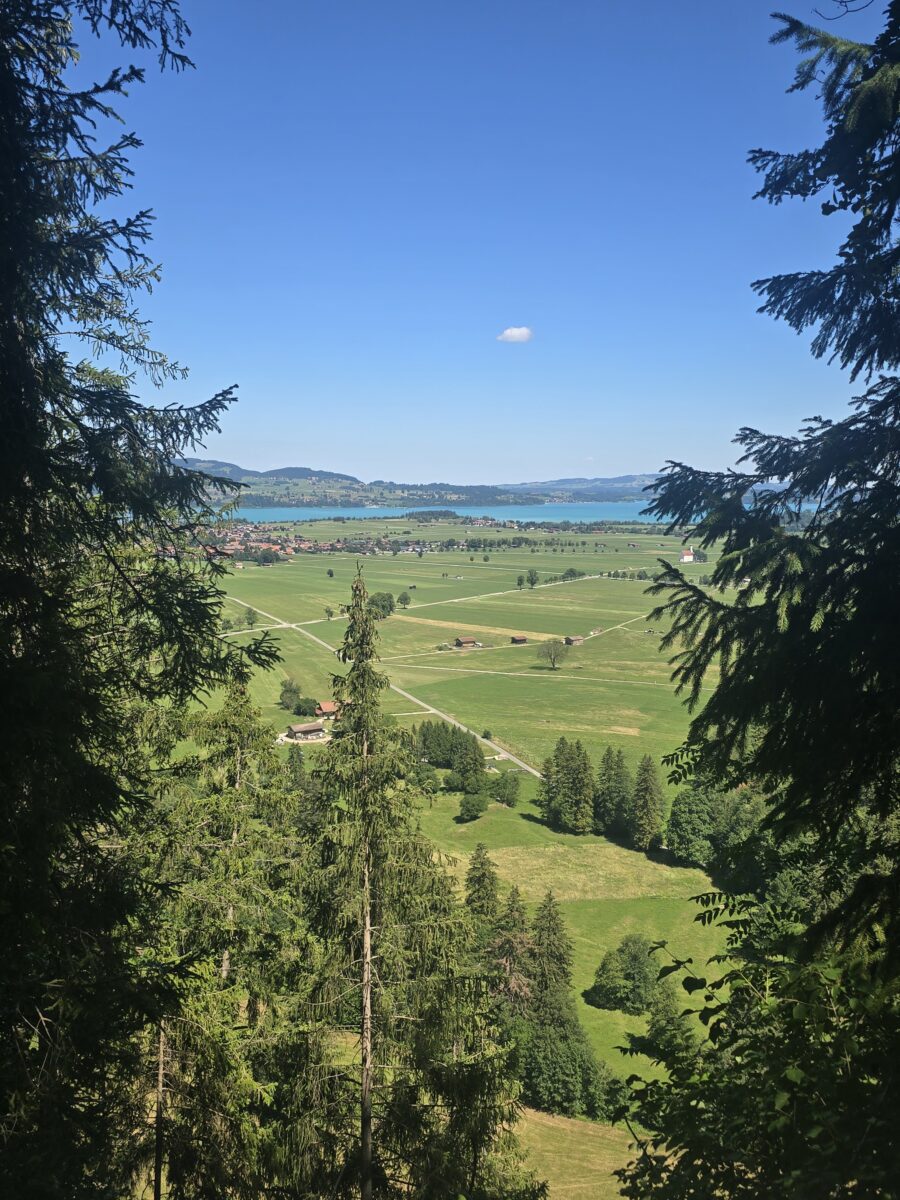
Füssen offered a gentle re-entry into civilisation. On the last metres through the forest we heard it approaching, an ambulance siren, a choir in the distance, and we toasted our arrival with a chilled drink in the old town. Over the following two days we let the week settle and visited Neuschwanstein, that fairytale stage set of a castle whose daily crowds made the contrast with our silent trail days instructive in itself. On the second-to-last day, a few hours alone in the spa gave me the space to process the week, and one insight stood out. For years I have known two modes of myself, a productive one that creates and delivers and is always reachable, and a quieter one that is simply present, connected to nature, to the Universe and to the people I love. The week had brought the second one back to life, and it left me with a third: a readiness to receive, which begins with letting go of the projects and people that drain rather than enrich. That, in the end, was the thought we had carried since day one, returned to us like an echo.
Why women need spaces like this
If this pilot confirmed one conviction, it is not about any particular trail. It is that women need spaces like this far more than we admit. Spaces where we are not somebody’s mother, daughter, boss or partner for a week. Spaces where we can be authentically ourselves, say the unpolished thing, walk in silence when we need to, and be met with understanding rather than expectation. What grows in such a space is not only rest. New connections form, support networks take root, and with them the courage to grow in directions we had quietly filed away as impossible.
On the last evening, someone raised the question I had been secretly hoping for: which trail could we walk next year? As for me, I notice that something has been switched on inside that I do not intend to switch off again. The message on our final card read: persist like water. Standing at the Lechfall, watching this patient, stubborn river thunder over the drop at the end of its wild run, it no longer felt like a card from a box. Water does not fight the rock. It simply keeps going, and it always finds a way. Because if this week taught me anything, it is this: the mountains do not solve your life for you. They give you back the clarity, the energy and the self that daily life so often erodes. And giving yourself permission to listen to your own needs is the greatest gift of all.
Questions to take on your own walk
Which dream have you been postponing, and what would it take to give it a date in your calendar?
Which projects, commitments or people drain your energy rather than enrich you, and what are you ready to leave behind?
When do you feel resistance, and what happens in you when things do not go your way?
Where in your life are you forcing a straightened channel, and what might happen if you allowed a little wildness back in?
If you are interested in joining me in next year’s walk, just drop me a line. I will announce the destination and dates in the autumn: [email protected]