









Editor’s Note: “Snežana Radojičić, widely known as Cyclonomad, is a distinguished Serbian travel writer, adventurer, and honorary member of ICJ. She is the author of several acclaimed books, including Roll Me Around the World, Nomad, and Planet Japan, through which she has brought her journeys to readers across continents. Beyond her literary work, Snežana dedicates herself to humanitarian efforts during her travels, supporting local communities and giving voice to those often unheard.
ICJ proudly presents her first travelogue from Australia, a powerful and deeply emotional encounter with Uluru — the sacred monolith of the Aṉangu people and one of the world’s most extraordinary cultural landscapes.“
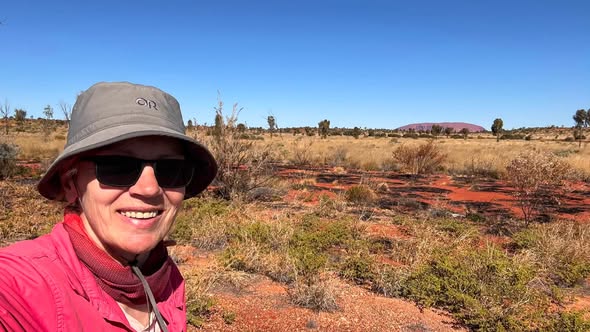
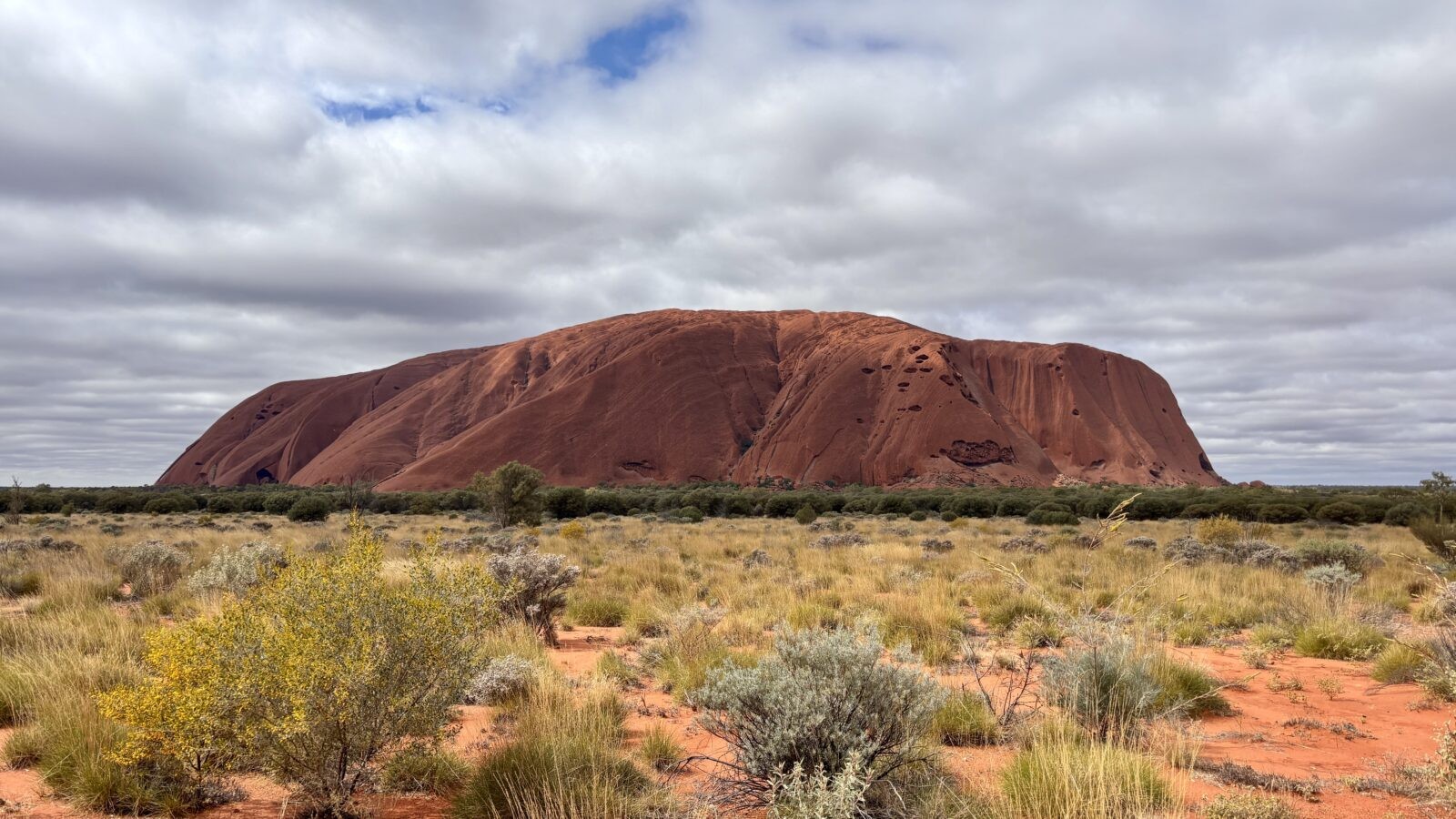
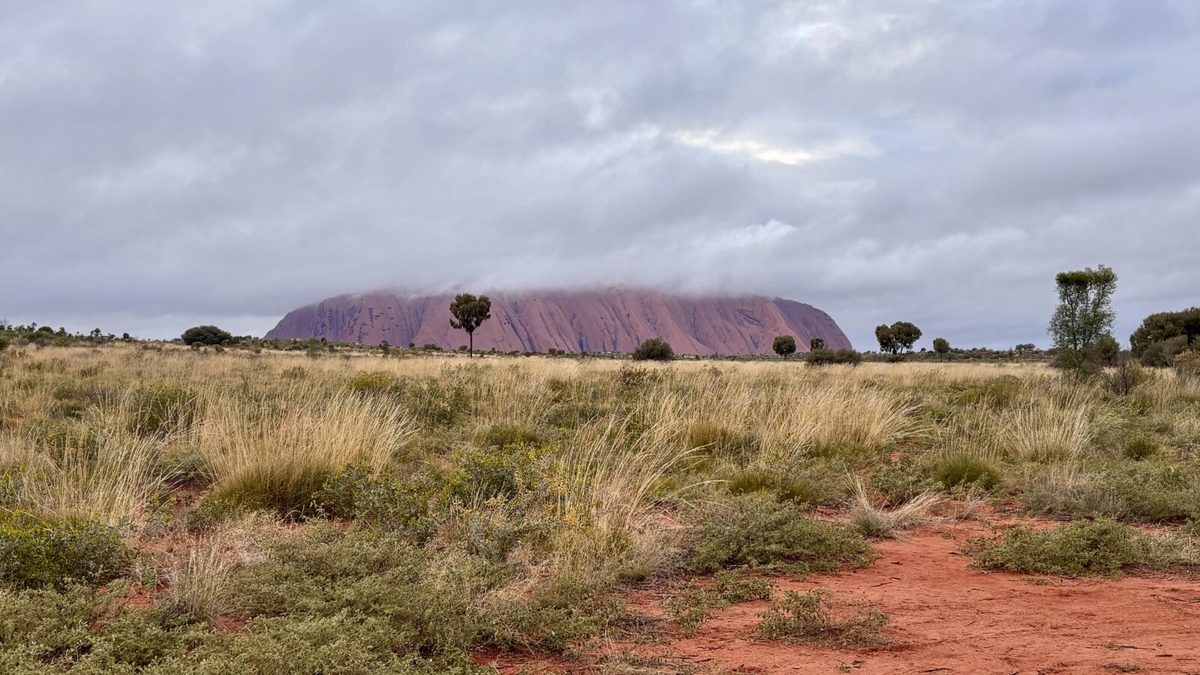
Uluru disappeared into a cloud. It rained last night and today the sky is gray and low, as if it could fall to Earth at any moment. The top of the sacred monolith is at 340 m, and now it is cut off.
The path leading to the rock winds, so the view constantly opens and disappears. As if the rock is playing hide‑and‑seek with visitors.
At least there won’t be crowds, I think. And I think about the videos and photographs I need to make, wondering how they will turn out. Sometimes I catch myself thinking like the most superficial influencer.
Maybe I shouldn’t have gone for a visit today. I’ve been here for two days already, but I was working on a new video and blog. I could have waited until tomorrow, although I’m in a hurry to continue the journey because of the weather conditions.
But it is what it is. Even in the fog I can ride a circle around the rock, which has a circumference of almost 10 kilometers. Maybe I will be able to touch the stone, thirty million years old. Science says that what is visible on the surface is only a fraction of what lies beneath the ground. Something like those icebergs at the North Pole. Or like the metaphor of the tip of the iceberg in the human psyche.
From Yulara, where I am camping, to Uluru it is a little more than twenty kilometers. I set off early, before dawn, and arrive right after opening.
In the parking lot I am stopped by a group of three young people unpacking bicycles for rent. Two guys, one from Britain, one from Germany, and a girl from the Netherlands. They are all on a work and travel program. They like my story, and I like them, so full of life, so I stay with them for a good half hour.
When the first tourists start to arrive, I say goodbye and set off for a ride. We’ll see each other again later, at the exit.
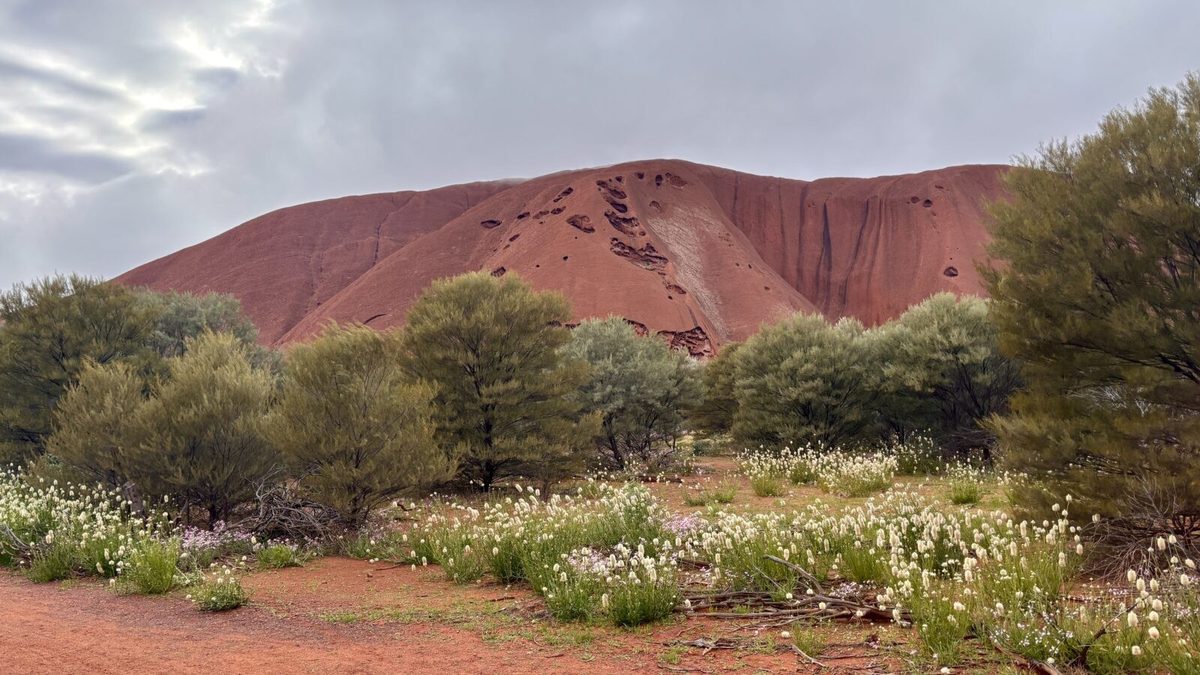
I know only a few facts about Uluru: that it represents a sacred place for the indigenous people and that until recently it was allowed to climb it, despite their appeals not to do so, and that only recently climbing was abolished and forbidden. I wonder how it is possible that the Australian government holds that land and develops serious tourism on it. Millions of visitors come to the heart of the Red Land to see the Rock. Driving to the tourist complex Yulara, at every turnoff to a dirt road there is a sign warning that this is indigenous land and that passage is not allowed, and violation of that rule will be punished with a high fine. How then is it possible that in the middle of that indigenous territory, its most important part, what represents a sacred place, does not belong to those indigenous people, but to the Australian government? Which, needless to say, has made a tourist‑commercial circus from which it collects huge royalties.
I ask AI for an explanation.
The indigenous people of Uluru, the Aṉangu people, lived in the area of Uluṟu for tens of thousands of years. UNESCO itself confirms that there is physical evidence of one of the oldest continuous cultures in the world.
William Gosse was the first recorded European to reach Uluṟu, in 1873. He named it Ayers Rock, after Henry Ayers, then Chief Secretary of South Australia. That was pure violence against already decimated Aboriginal tribes. The Aṉangu already had their own name, their own stories, their own paths and their own relationship to the place. The European naming was not the “discovery” of an empty space.
At the beginning of the 20th century the area was declared an Aboriginal Reserve. But that did not mean that the Aṉangu received ownership rights in the modern sense. On the contrary, later the traditional owners spoke about being driven into the reserve.
In the forties and fifties, when the access road was built and tourism began to grow, Uluṟu was excluded from the Aboriginal Reserve. In 1950 it was declared Ayers Rock National Park. That is a huge paradox: the land was taken away from the people who traditionally possessed it so that it could be declared a national park.
In the seventies the Aṉangu began to demand more strongly the return of the land. At meetings in 1971 the traditional owners spoke about the problems brought by livestock farming, mining, desecration of sacred places and tourist pressure.
After the adoption of the Aboriginal Land Rights (Northern Territory) Act 1976, the situation became even more interesting: Uluṟu was excluded from the law so that it would remain a national park, meaning, in the ownership of the Australian government.
The key years were between 1983 and 1985. After more than 35 years of campaigning, the government of Bob Hawke announced that it would return ownership to the traditional owners. And finally, on October 26, 1985, Governor‑General Sir Ninian Stephen handed over the ownership documents to the Aṉangu.
But immediately afterwards something so paradoxical happened that it is hard to believe: five minutes after the handing over of the ownership document, the Aṉangu leased the land to the Australian state for 99 years, so that the national park could continue to exist. What a farce!
Even today the legal situation is such that the Aṉangu own Uluṟu and Kata Tjuṯa, and lease the land to the Australian government. The park is managed jointly, and the management board has a majority of Aṉangu members.
I wonder, what kind of members? Incorruptible and faithful to tradition, whose people’s well‑being is above personal interests? It does not seem that such are in the Board.
UNESCO in 1987 recognized the natural value of the park. Seven years later, Uluṟu‑Kata Tjuṯa was inscribed on the UNESCO list for the second time, this time for its cultural value. Thus it became one of the rare places in the world that UNESCO protected on two grounds, precisely because the natural landscape cannot be separated from Aṉangu culture and the thousands of years old relationship to the land.
When it comes to climbing, after decades of debate, climbing on Uluṟu was permanently closed in October 2019.
In some media this was presented in a caricatured way, as if the Aṉangu simply asked tourists not to climb. But the story is much deeper: climbing was painful for them because Uluṟu is a sacred place, but there was also a history of injuries, deaths, waste and physical damage to the site.
Ouch.
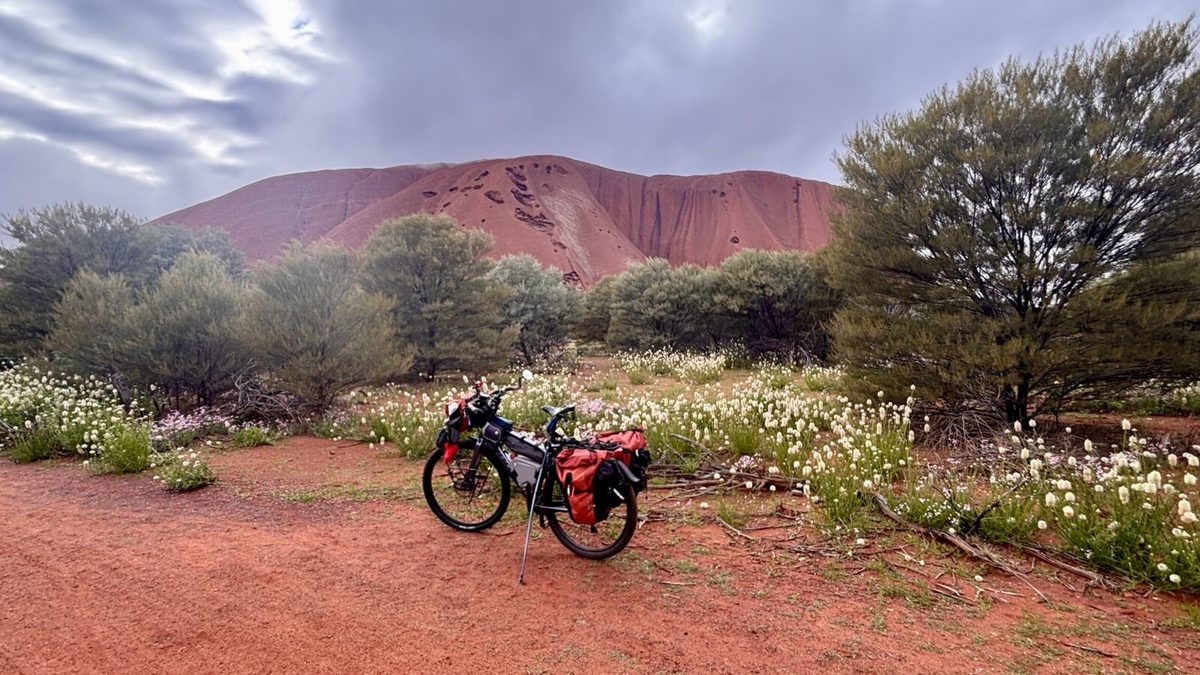
When touring Uluru there is a rule: pedestrians walk clockwise, while cyclists ride in the opposite direction. In this way collisions and possible injuries are avoided, since the path is not always visible, both because of the configuration of the terrain itself and because of the lush vegetation around the rock. Of course, not everyone follows that rule, and many are not even aware of it.
Along the parts of the rock where there is no high vegetation, a rope is stretched. Signs are frequent asking tourists not to leave the path, because sometimes it takes weeks for the traces of numerous visitors to disappear again and for the red sand to blend with the surroundings.
From time to time I come across signs asking visitors not to photograph certain parts of the rock. On the Parks Australia website they say that these are culturally sensitive and sacred places. The details and shapes of the rock at those places for the Aṉangu are equivalent to sacred scriptures – they carry cultural knowledge that should be seen at the original site and by people who have the right to know it.
At other sensitive places the rule is a little different: visitors can photograph plants, animals and people, but should avoid including rock formations in the frame. Namely, the very shape of the rock at those places conveys certain cultural knowledge. The same source explains that certain parts of Uluru contain chapters of creation stories and knowledge that should be taught only to people who have cultural authority for it. That is why the Aṉangu ask that those parts not be photographed and that their details not be reproduced outside the site.
As far as I noticed, almost no one tried to break those requests, even though there are no guards standing nearby, nor cameras that would possibly record violators of that rule. At one point, in front of the largest cave at the foot of the rock, I overlooked a sign prohibiting filming. Some tourist kindly pointed it out to me and I quickly deleted the recording.
In the previous two days I met several people in the camp who told me that they had visited at the time when climbing was allowed. And that they climbed. I am sure I would not – how is it even possible to set off to a place that for an entire people, and a people on whose territory you are, represents a sacred site? As if I came to someone’s house as a guest and, despite his explicit request, entered rooms he asked me not to enter. And for what reason? To satisfy my ego?
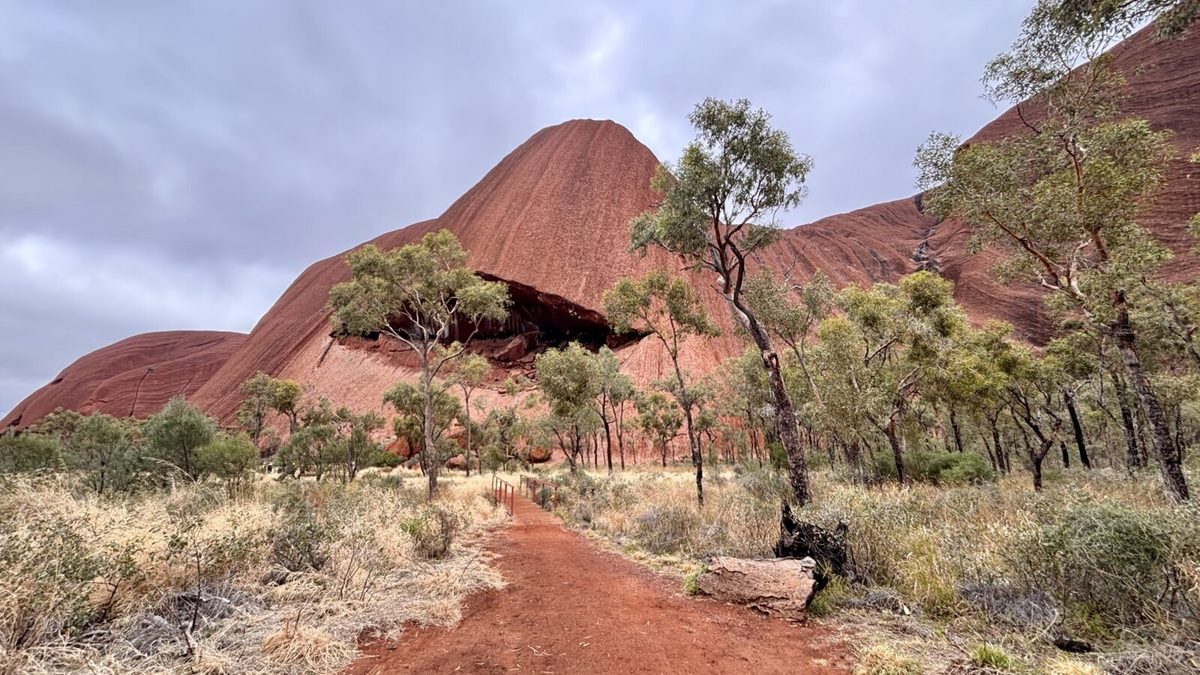
My first impression of Uluru is that it is enormous. I don’t know whether it is more impressive when viewed from a distance, or when standing at its base and trying with my eyes to reach the top. In the meantime the sky has cleared, so although there is no sun, the summit can now be seen quite clearly.
The greatest number of world‑famous places, whether created by Nature or by people, affect me in a way that could be called rational disbelief. That is when you know the basic facts about what you are looking at, everything is rationally clear to you and you understand how and when, and sometimes even why it was created, but your admiration remains in the domain of the aesthetic, based on critical judgment which confirms to you that it is indeed great, and important, and truly valuable. Sometimes the story behind it strikes you emotionally, but still all of it together remains rationally explainable.
Very rarely, so rarely that I can barely remember one or two such cases during fifteen years of traveling around the world, it happens that what I see permeates me to the depth of my soul. And always in the same order:
First comes the mentioned rational disbelief, admiration and recognition, but with the feeling that in fact I have not seen anything. That I have not grasped the essence, have not even sensed it.
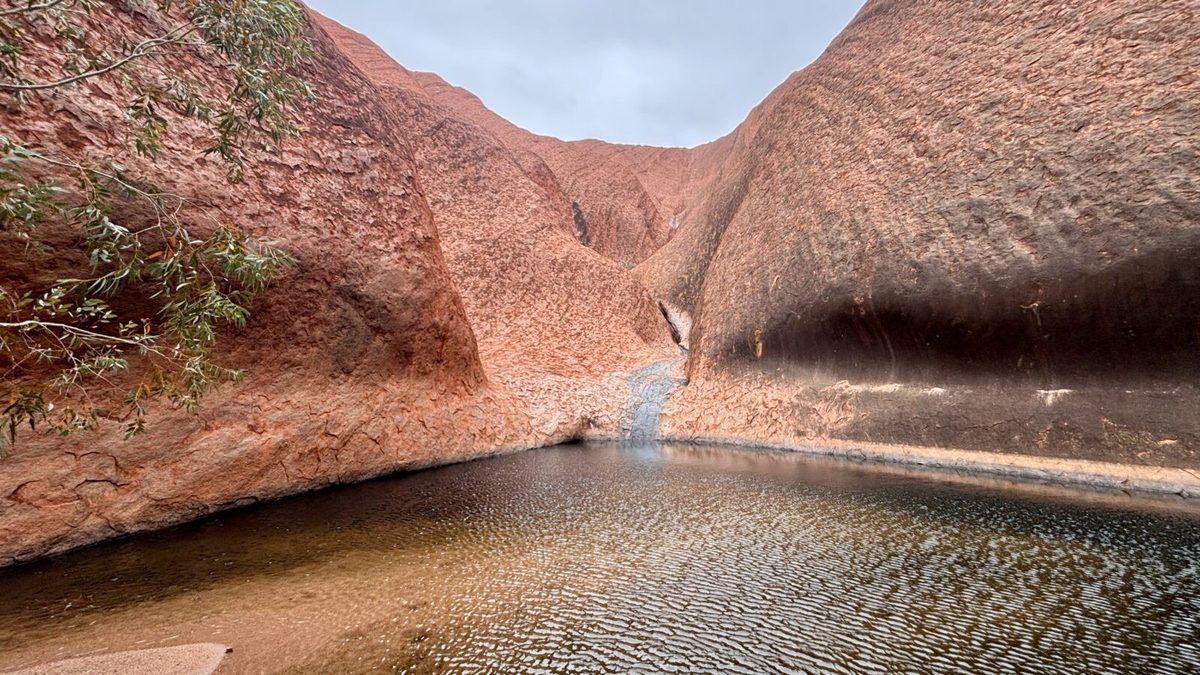
But if I manage to allow myself some time of isolation at that place, far from tourist hustle and noise, sometimes I experience a special state that could most closely be described as primordial tranquility and timeless permeation with peace and silence. A state very similar to deep meditation. I become one with that place. And then I know that this is – it. I have understood something, however small it may be, but I do not leave from there only with a visual impression. I also have a certain, personal feeling of what I have seen.
This second happened to me in the American Grand Canyon. Suddenly it permeated me with such strength that I had the feeling that I belonged there. More precisely, that I had belonged there. That I had once long ago been a squaw who lived there.
And the first time I experienced it was in Peru, in the place Pisac, looking at the terraces built by the Incas, which are larger than those in Machu Picchu. Until then, as a fierce advocate of exclusively rational knowledge, a woman with both feet firmly on the ground, who without blinking rejects everything that even smells of spirituality, because everything connected with it she considers false – such me in a moment was permeated by a feeling of already seen, déjà vu. Beyond everything I had ever believed in, but so strong and certain that I did not even try to deny it. Nor to explain it to myself.
Today I first felt rational admiration, but also that it remained there unfinished and incomplete, as if I had come in vain, because I already knew all that from photographs and recordings.
Something was missing and I had to at least try to find it.
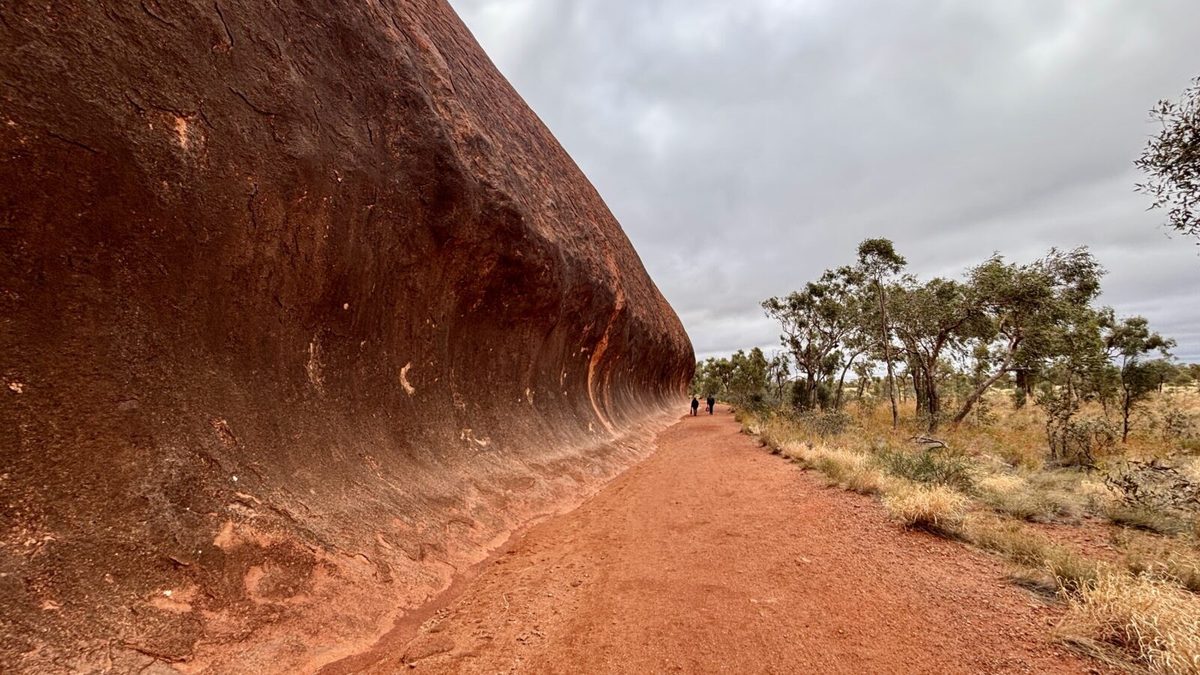
After finishing the circle I drove to a short walking trail away from the rock. I found a sheltered place with a view of the monolith. I opened the camping chair I had brought and made myself coffee. Then I sprawled out and sat with a view of the high natural wall. I waited to feel something. For it to tell me something. To hear. But nothing happened.
After some time, I reconciled myself with that. I packed up and slowly headed toward the exit. But then I stopped to record short video clips intended for a group of my dear friends, as well as for one new friend.
I stood astride the bicycle, facing the rock. I had already finished filming, so I leaned my elbows on the handlebars, and just looked at what was in front of me. And then it happened.
First I was permeated by a feeling of complete tranquility, as if I were one with the ancient monolith. It is a state that cannot be described with suitable epithets, because it is neither beautiful, nor happy, nor positive, nor negative. It is a state of presence, complete presence, without the experience of the Self that relates to it. I was there, in that moment, connected and empty in the way described by all meditative practices.
And then I felt enormous pain. Not the romantic kind, like Weltschmerz, but deep, non‑human, so all‑pervading that it cannot be endured.
Only once in my life had I felt something similar: after returning from the Arvacos tribe, in those days when I was meditating intensely. In the middle of one meditation it permeated me so strongly that I thought: “With this much pain one cannot live.” I have never had suicidal ideas, nor am I inclined to them, but then I realized that such a feeling would inevitably lead to that. Simply, with that inside oneself there is no life. Of course, I got scared and, I don’t even know how, managed to get out of that state and recover.
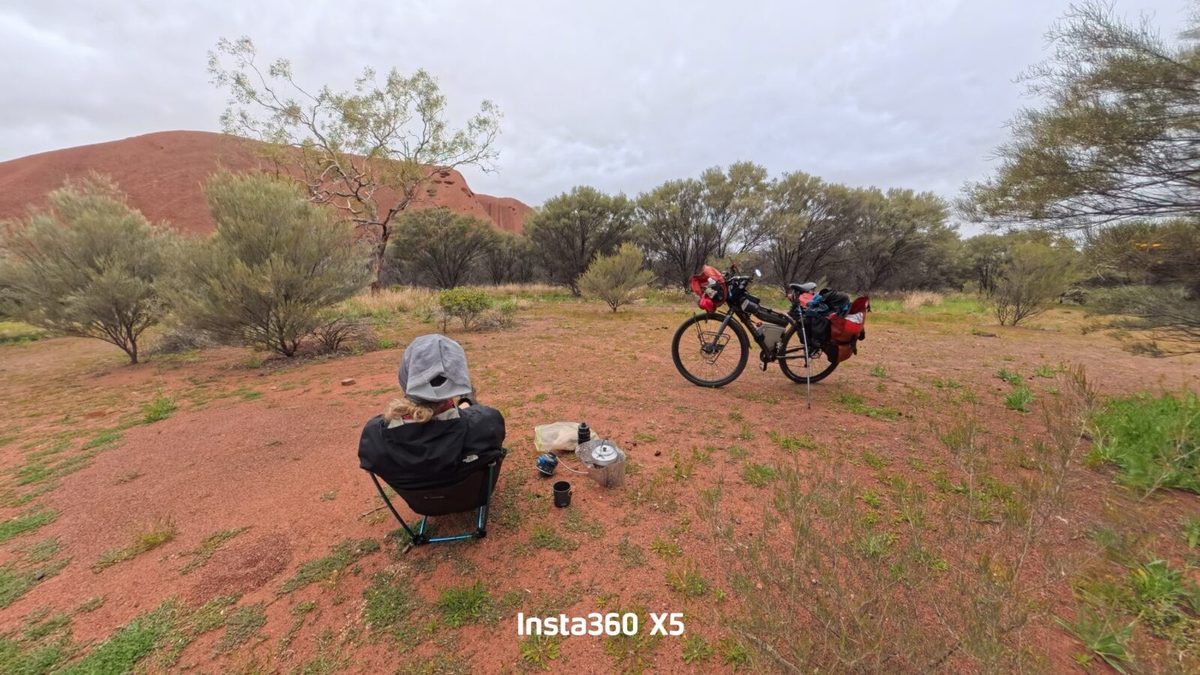
This time something similar happened. From the start I recognized it. It was not clear to me where it came from. Does it have to do with the difficult fate of the indigenous people? But energetically, the place was not negative – it just hurt me hellishly in the chest. Everything else, every other feeling, every other thought – was completely irrelevant. I was overwhelmed.
I could no longer look at that seemingly tranquil monolith. I could no longer be there. I did not know where to put myself to escape from that pain.
I pedaled back and did not look back once.
While I was riding toward the camp, suddenly a thought struck me:
“What if that pain is in you? What if it is yours?”
Maybe all my defense mechanisms disappeared in that moment of tranquility, allowing what I carry inside myself to surge and overwhelm me so unprotected?
Or perhaps Uluru caused it?
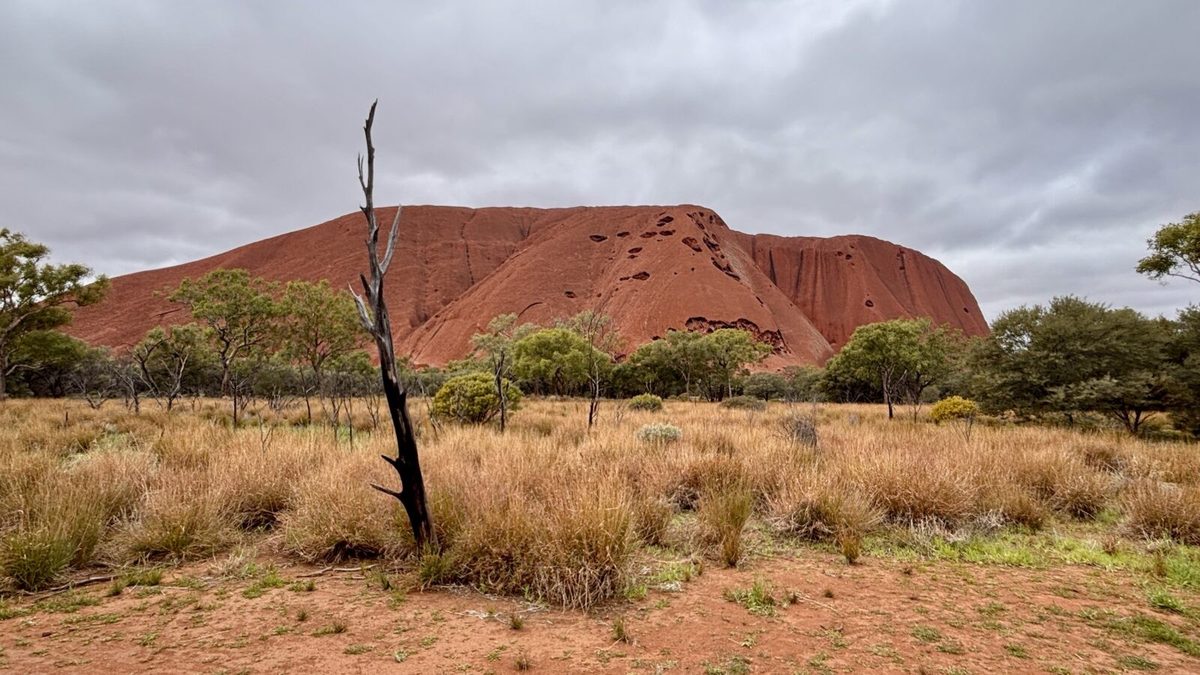
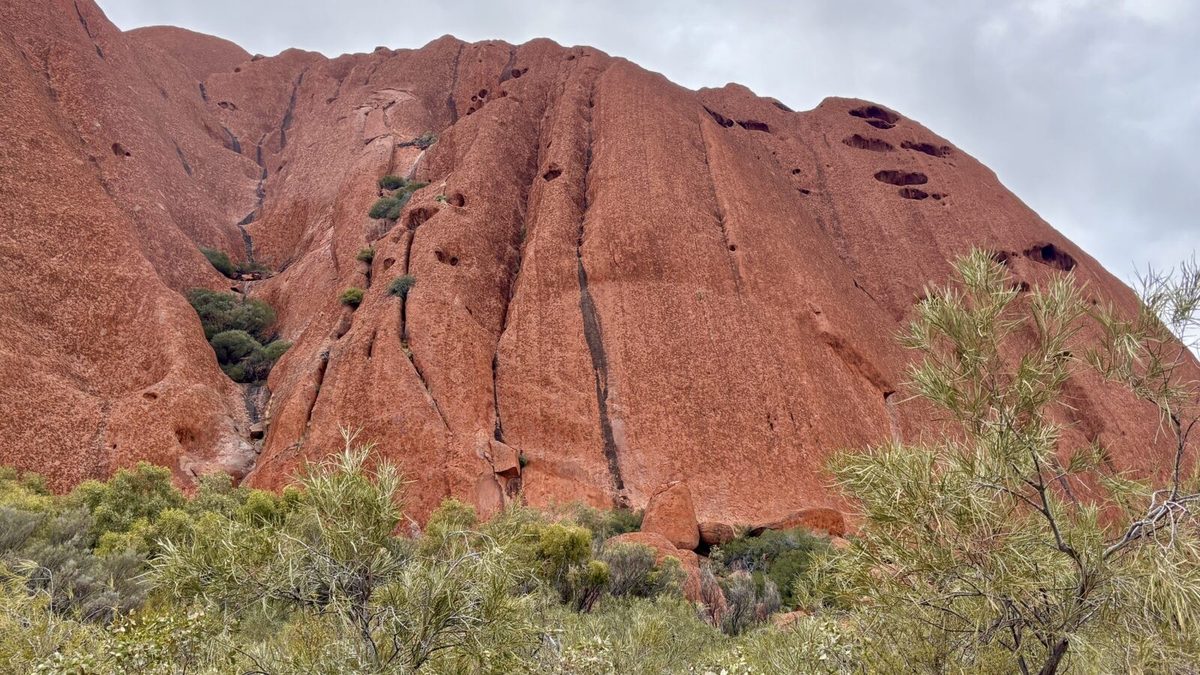
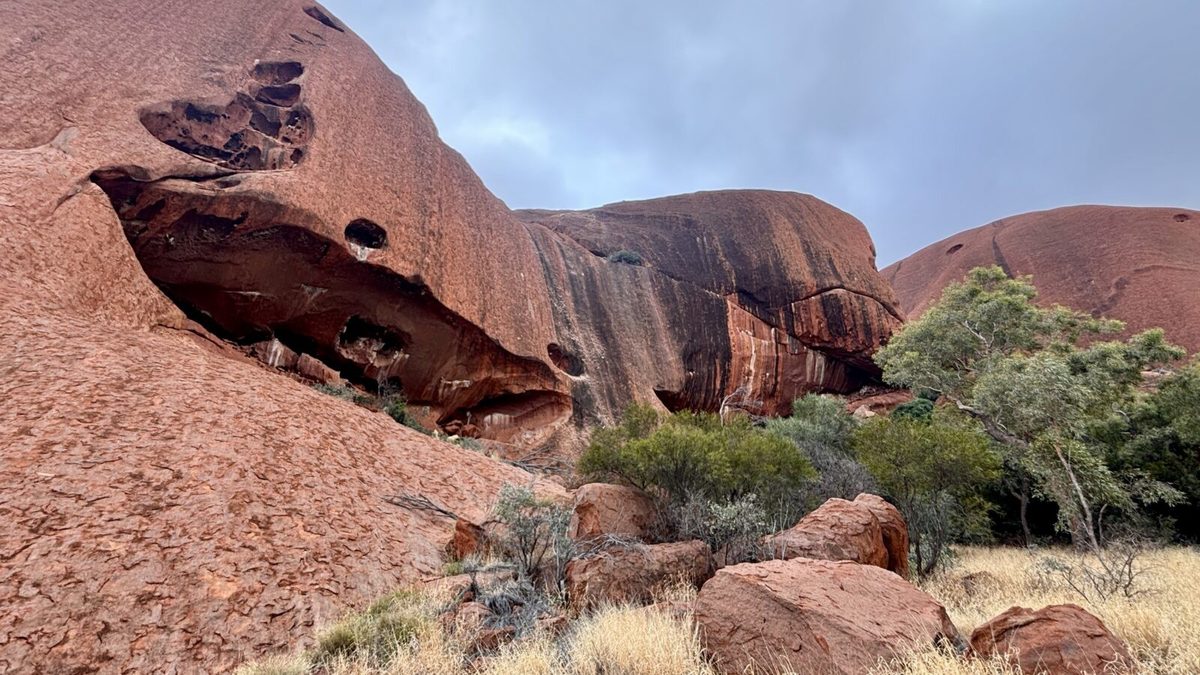
The rock that remembers half a billion years. Cavities in it like eyes that witnessed the time of creation, the shaping of the earth and the life of the Aṉangu people, and then the sudden cut in the form of colonial violence, land dispossession, marginalization and violent attempts at assimilation of a people. Did that trigger what I myself suppress to the bottom of my soul and what I have fenced off with high walls like this monolith, because with that one could not live?
I do not know and I do not want to return to find out.
At the exit from the park a young Briton asked me for impressions. I briefly told him everything – as if I had to share it with someone, so that I could free myself as quickly as possible and return to myself, the “me” who keeps her pain behind 340‑meter‑high walls.
“Interesting. But many visitors experience something similar. And they say they would never return, no matter how much they liked the place,” said the young man.
That was the moment I truly became confused.
Discover her stories, books, and humanitarian work — and follow her adventures directly at her official website https://snezanaradojicic.com/
For more vivid insights into her journeys, please visit Snežana’s official YouTube channel: https://www.youtube.com/@CIKLONOMAD