



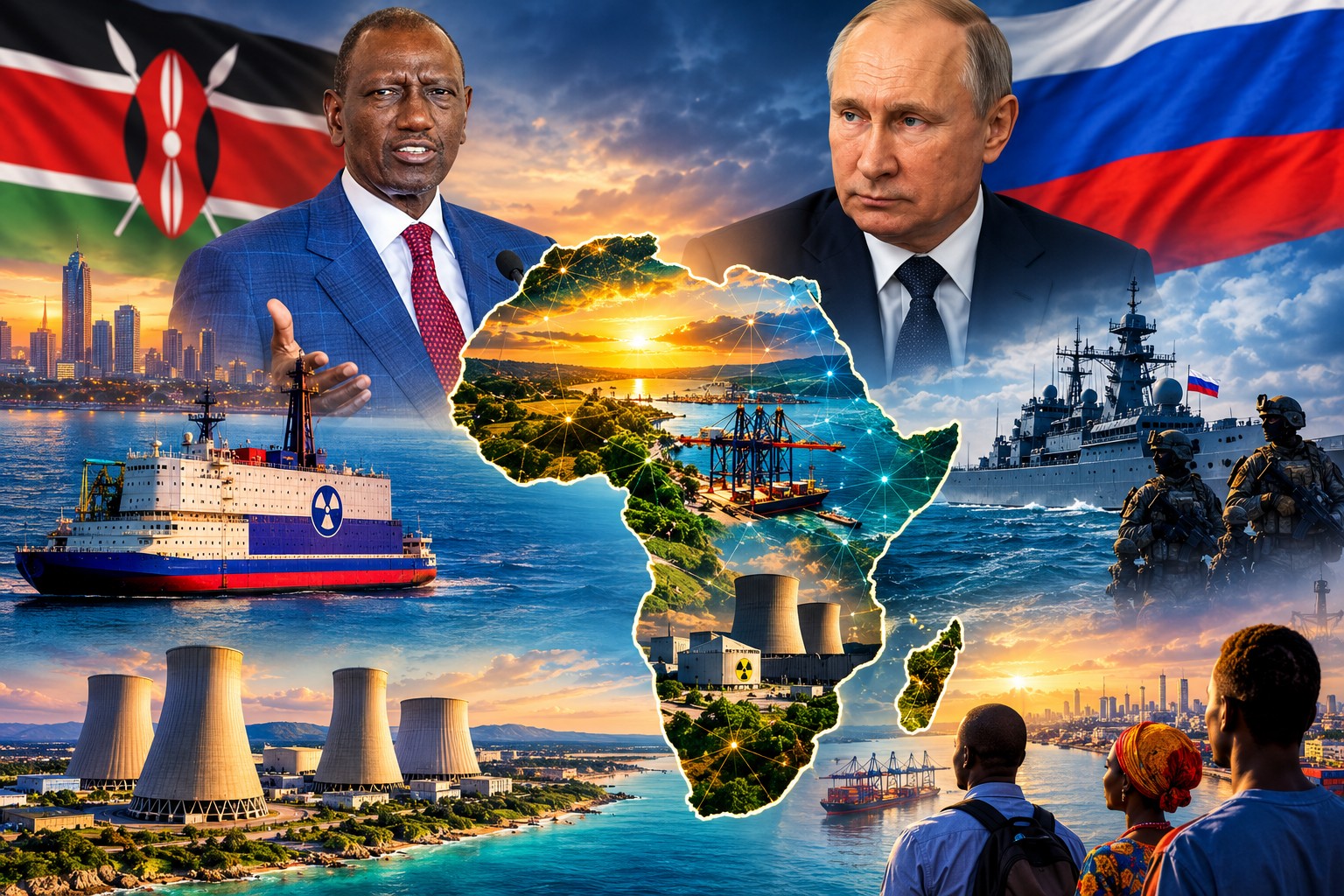

From floating nuclear reactors and strategic ports to military agreements and the war in Ukraine, Moscow is deepening its engagement across Africa. President William Ruto’s recent visit to Russia has brought Kenya into sharper focus, but the bigger question is whether a continent desperate for electricity and investment could become increasingly exposed to the rivalries of the world’s major powers.
Nairobi, Kenya — Russia is offering Africa a powerful proposition. It promises to bring electricity to coastal nations through floating nuclear power plants, opening a potential new route for countries struggling with blackouts, expensive fuel imports and the demands of rapidly growing economies.
But beneath the promise of reliable power lies a far bigger geopolitical calculation.
The proposed reactors would not operate independently of Russia. Their fuel, specialised maintenance, technical expertise and eventual decommissioning could tie host countries to Moscow for decades. Their locations would place them along coastlines where commercial ports, international shipping routes and military logistics already intersect with the strategic interests of major powers.
At a time when the war in Ukraine continues to shape relations between Russia and the West, tensions in the Middle East threaten vital shipping corridors, and governments are increasingly competing for influence across the Global South, the implications extend far beyond energy.
For Africa, the question is no longer simply where the next megawatt of electricity will come from. It is who will control the infrastructure that produces it, who will protect it, and what political obligations might follow.
The stakes became particularly visible in Moscow on 28 October 2026, as African delegations gathered for the Third Russia-Africa Economic and Humanitarian Forum. Among the leaders making the journey was Kenyan President William Ruto, whose visit placed Nairobi’s growing engagement with Moscow within a much wider continental contest for investment, technology, markets and strategic influence.
Ruto’s message was economic. Russia, he argued, should invest in African industries rather than see the continent merely as a destination for its manufactured goods.
“For too long, Africa’s engagement with the global economy has been defined by the export of raw materials and the importation of manufactured goods, with much of the value, industry and employment created elsewhere,” Ruto said.
“Our ambition is not to divide existing value differently, but to create more value together and share in the prosperity it generates,” he added.
It was a compelling case for economic transformation. Yet the question confronting African governments is whether deeper relationships with Moscow will deliver that transformation without creating new dependencies.
Russia’s floating nuclear proposal offers a revealing test.
Russia’s nuclear offer reaches beyond electricity
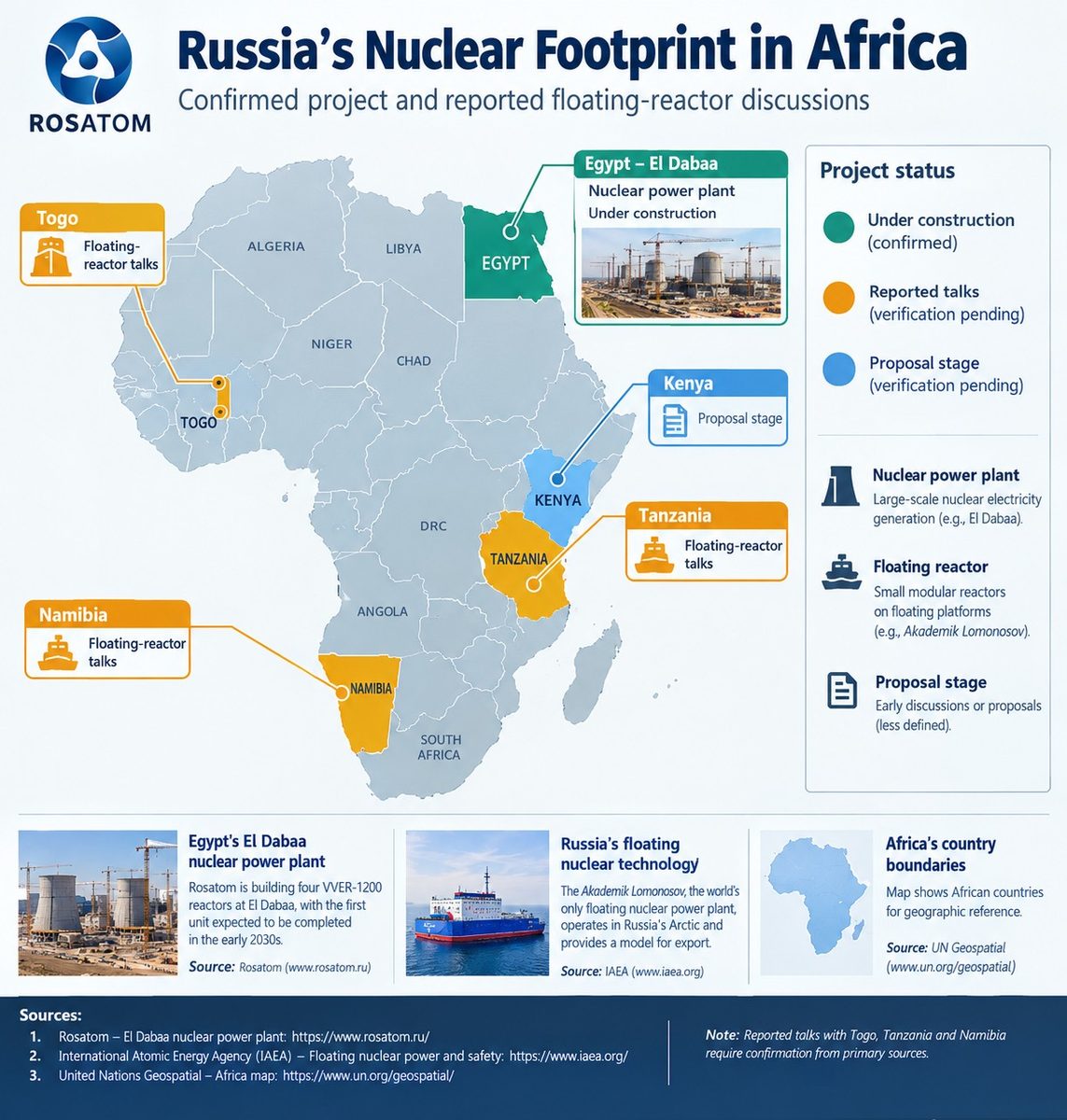
Rosatom, Russia’s state nuclear corporation, says it is in advanced discussions with Egypt, Togo, Namibia and Tanzania over the supply of floating nuclear power plants. Each proposed unit would produce approximately 100 megawatts of electricity using the company’s RITM-200M reactor technology, adapted for warmer climates.
The concept is straightforward. Rather than constructing an entire conventional nuclear power station on land, a reactor could be assembled in a Russian shipyard, transported by sea and connected to a suitable coastal electricity grid.
Rosatom says this approach could reduce some of the construction time and infrastructure requirements associated with conventional nuclear projects.
For governments confronting severe energy deficits, the attraction is obvious. Reliable electricity is essential for industrialisation, hospitals, water infrastructure, digital services and manufacturing. Without it, African economies struggle to create jobs, attract investment and compete in global markets.
The International Energy Agency has repeatedly identified electricity access, energy investment and infrastructure as major challenges for sub-Saharan Africa. Hundreds of millions of people across the region still lack access to electricity, while many more experience unreliable supply.
Russia is seeking to position itself within that enormous unmet demand.
Vladimir Aptekarev, deputy head of Rosatom’s machine-building division, said 38 of Africa’s more than 50 countries have coastlines capable of hosting a Russian-made floating power unit.
“As a first step, a floating nuclear power unit can serve as a good entry point, enabling a country both to address its energy needs and to join the nuclear club,” Aptekarev said.
The statement captures the commercial and geopolitical appeal of the proposal. A country could gain access to nuclear technology without first developing every element of a conventional nuclear industry.
But the phrase “entry point” deserves attention. Nuclear power is not simply a product delivered to a customer. It requires a regulatory system, highly trained personnel, emergency planning, specialised fuel arrangements, long-term maintenance and a credible strategy for managing radioactive waste and decommissioning.
When a foreign supplier provides several of those services, the relationship can extend far beyond the original purchase.
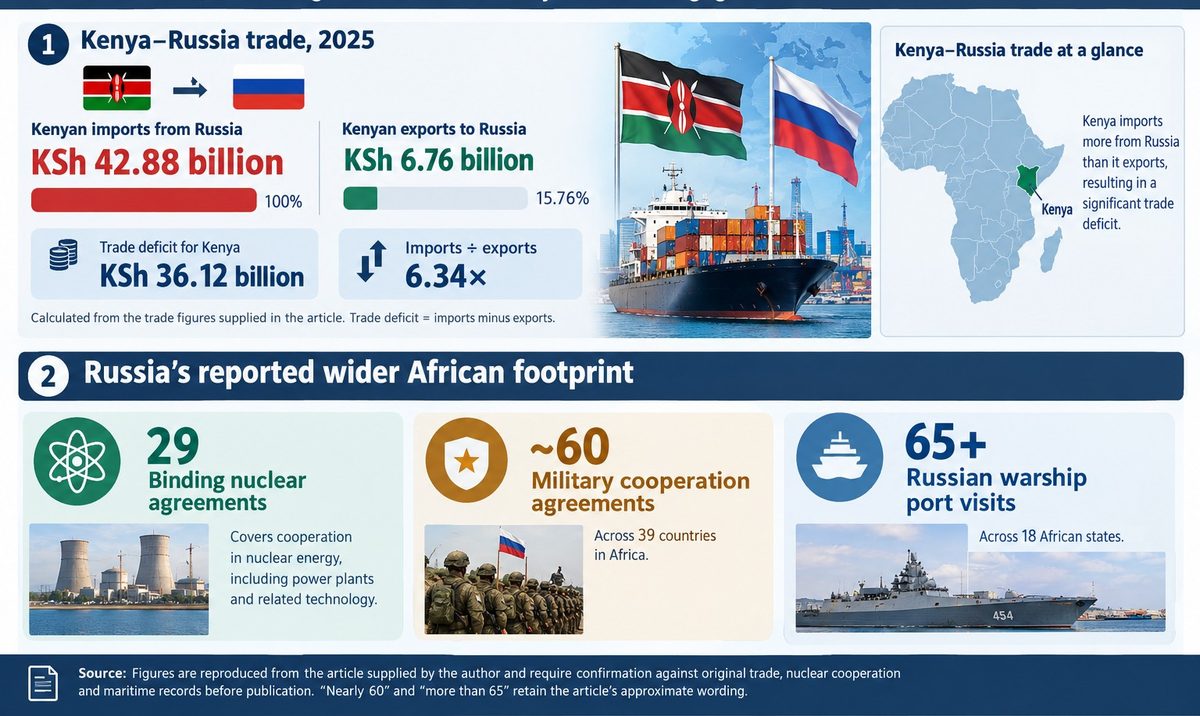
Rosatom chief executive Alexei Likhachev said the company has legally binding agreements with 29 of Africa’s 54 countries and is in active discussions with between 40 and 42. He also said Rosatom was developing nuclear projects of different capacities and configurations in 15 countries.
Those figures, as reported in the original account of the Moscow forum, point to an extensive engagement strategy. They do not mean that all the countries involved have approved nuclear plants or are receiving reactors. The distinction between a signed cooperation agreement, a preliminary discussion and an operating facility is essential.
Nevertheless, the breadth of the reported network demonstrates why Russia’s nuclear diplomacy deserves to be examined as a continental issue rather than a collection of isolated energy projects.
The 60-year question
A floating nuclear reactor could have an operational lifespan of up to 60 years, according to Rosatom’s stated proposal.
That is a remarkable period in political terms. A contract signed by one administration could outlast several presidents, multiple elections and generations of national energy policy.
Rosatom says refuelling and servicing would be carried out in Russia. Such an arrangement could provide access to specialised expertise while reducing the burden of establishing every technical capability locally.
It could also leave a host country dependent on an external supplier for essential services.
What happens if relations deteriorate? What happens if sanctions disrupt payments, shipping or access to components? What happens if a disagreement over maintenance becomes a dispute about electricity supply?
There is no public evidence presented here that Moscow has used its nuclear energy relationships to coerce African governments. The concern is that dependence could create leverage even without an explicit threat.
A country that relies on a foreign-operated reactor for a substantial share of its electricity may find it more difficult to change its diplomatic position when its energy security depends on maintaining that relationship.
This is particularly significant in a world where governments increasingly use trade, finance, technology and energy relationships to advance national interests.
The same questions should be asked of Western, Chinese and other foreign suppliers. Strategic dependence is not unique to Russia. The difference lies in the particular combination of nuclear cooperation, military engagement and geopolitical confrontation surrounding Moscow’s African relationships.
African governments therefore need to scrutinise the entire commercial arrangement, including financing, fuel supply, maintenance, security, insurance, liability and decommissioning.
A reactor’s headline cost tells only part of the story. Its full economic impact emerges over decades.
Why Russia’s presence on African coastlines matters
The geography of floating nuclear power gives the proposal another dimension.
The reactors would be placed near coastlines, potentially close to ports, commercial shipping routes and major population centres. Those locations are economically attractive because maritime transport can facilitate the delivery of equipment and other specialised services.
They are also strategically important.
Africa’s coastlines connect the Mediterranean to the Atlantic, the Red Sea to the Indian Ocean, and major commercial centres to some of the world’s busiest maritime corridors.
The Suez Canal and Red Sea are critical to trade between Europe and Asia. The Gulf of Aden connects those routes to the Indian Ocean. Atlantic-facing ports serve major trade networks linking Africa with Europe and the Americas.
Disruptions along these routes can raise shipping costs, increase insurance premiums and delay essential imports.
Russia has sought to expand its maritime and security relationships across the continent. The original reporting cited more than 65 Russian warship port visits to at least 18 African countries between 2020 and 2025. It also identified Russian interest in port access and logistics arrangements in countries including Togo, São Tomé and Príncipe, Equatorial Guinea, Sudan, Somalia and Eritrea.
These activities must be distinguished carefully. A naval visit is not the same as a permanent base, and an agreement on military cooperation does not automatically establish a foreign military installation.
But taken alongside Moscow’s wider diplomatic ambitions, they illustrate why African ports have become important in international strategic competition.
A floating nuclear plant would require a secure berth, technical access, emergency-response systems and arrangements for protecting the facility. The precise requirements would depend on its design and operating model.
Those arrangements could overlap with wider port security and maritime infrastructure. That does not prove that a civilian nuclear project would be militarised. It does make transparency about ownership, access rights and security responsibilities essential.
African governments must retain clear authority over their territory and critical infrastructure. Any agreement involving foreign security personnel should specify their legal powers, command structure, accountability and limits.
The crucial issue is not whether Russia can operate a reactor safely. It is whether the host country will have the institutional capacity and legal authority to supervise the entire arrangement independently.
From nuclear cooperation to military influence
Russia’s African engagement extends beyond energy.
Its security relationships have included military training, equipment, defence agreements and cooperation with governments facing insurgencies and internal instability.
The Africa Corps structure has assumed functions previously associated with the Wagner Group, which became prominent in several African conflicts and security partnerships. Russia’s role has been particularly visible in countries including Mali and the Central African Republic, alongside wider engagement in the Sahel and North Africa.
The original article cited research by Sweden’s Defence Research Agency identifying at least 57 Russian military and security agreements involving 39 African countries. It also reported that Russia had concluded nearly 60 military cooperation agreements by March 2026.
Those totals should be checked against the underlying research before publication, including how agreements are defined and whether the figures refer to signed documents, active partnerships or arrangements of varying practical significance.
The broader point remains important. Moscow’s relationships across Africa encompass multiple sectors, from energy and mining to military cooperation and diplomatic engagement.
The combination creates a network of interests that can reinforce one another.
A government may seek Russian investment in energy while also relying on Russian equipment, training or security assistance. Such relationships can provide practical benefits, but they can also make it harder to diversify partnerships if political disagreements emerge.
A floating reactor would not automatically become part of that security network. Nuclear power and military cooperation are distinct activities. However, when they exist within the same bilateral relationship, governments should assess their combined implications rather than treating every agreement as strategically isolated.
The question is whether African states are strengthening their capacity to make independent decisions or accumulating obligations that narrow their choices.
The world war question and Africa’s exposure
Talk of a possible third world war has become part of wider public debate as conflicts and strategic competition intensify. But it is important to distinguish the possibility of escalation from evidence that a global war is imminent.
For Africa, the immediate risks of a wider confrontation would be economic and strategic as well as military.
An expanded conflict involving major powers could disrupt maritime trade, complicate financial transactions and increase the cost of imported fuel, grain and fertiliser. African countries that depend on international supply chains would be exposed to price shocks and shortages.
The effects could spread rapidly from ports to markets, farms, factories and households.
A floating nuclear reactor would add a specific set of safety and contingency considerations. An incident involving a facility near a populated coastline could demand specialised emergency response, while damage to critical infrastructure could complicate electricity supply and maritime operations.
That does not mean a reactor would necessarily become a target in a conflict. Nor does the proposal provide evidence that Russia intends to deploy nuclear weapons in Africa. Those are separate claims that should not be confused with civilian nuclear cooperation.
The legitimate concern is whether host governments are adequately assessing the risks of placing critical infrastructure within an increasingly contested strategic environment.
Would emergency services have the training and resources to respond to a nuclear incident? Would the country have access to independent technical advice if relations with the supplier deteriorated? Would insurance and liability arrangements remain effective during an international crisis?
These are questions of national resilience.
The broader lesson is that energy security cannot be measured only by installed capacity. It also depends on whether a country can keep its electricity system operating during external shocks.
Putin’s multipolar world and the competition for Africa
Russian President Vladimir Putin has repeatedly presented Moscow as a champion of a multipolar international order, challenging what Russia portrays as Western dominance.
Africa is important to that vision because of its population, natural resources, growing markets, diplomatic influence and strategic geography.
At international forums, African governments have often emphasised the right to pursue independent foreign policies rather than align automatically with competing global blocs.
That position reflects a practical calculation. African states need investment, technology, affordable financing, access to export markets and security partnerships. No single foreign partner can necessarily meet all those needs.
Russia is seeking to exploit that opening through energy cooperation, trade, diplomacy and security engagement. Its nuclear proposals offer a long-term relationship in a sector where switching suppliers can be expensive and technically difficult.
Putin used the Moscow summit to promote a target of $50 billion in Russia-Africa trade, according to the original reporting.
But the size of the trade relationship is only one measure of its value. The more consequential question is whether the partnership creates productive capacity inside African economies or leaves them reliant on imported technology, external expertise and foreign-controlled supply chains.
That is where the interests of African governments and Russia’s strategic ambitions may not always coincide.
Moscow wants reliable commercial relationships and greater international influence. African governments want development, jobs, infrastructure and the freedom to make their own decisions.
Those objectives can overlap, but they are not identical.
The responsibility of African leaders is to negotiate agreements that advance their countries’ interests, regardless of the political language used by the partner offering them.
Kenya brings the wider contest into focus
Ruto’s visit to Moscow has brought Kenya into the centre of this debate, but Nairobi is only one part of a much larger continental picture.
Kenya’s interest in Russia is rooted partly in the search for investment, new export markets and technology. Ruto urged Russian businesses to invest in manufacturing and use Kenya as a regional gateway.
Yet trade figures cited in the original reporting reveal a substantial imbalance.
Kenya imported goods worth approximately KSh42.88 billion from Russia in 2025, while exports in the opposite direction stood at about KSh6.76 billion. The difference was more than KSh36 billion, with imports roughly six times the value of exports.
The figures illustrate the challenge of converting diplomatic engagement into a more balanced economic relationship.
Ruto’s argument that Africa must retain more value from its economic activity is therefore particularly relevant to the nuclear debate. If a country imports the technology, depends on the supplier for specialist maintenance and sends payments abroad for essential services, the domestic economic benefits must be assessed against the full lifetime cost.
A successful partnership should create local skills, strengthen institutions, support industry and improve the reliability of electricity. It should not simply increase the value of contracts signed with foreign companies.
Kenya’s relationship with Moscow also carries a human cost that complicates the diplomatic picture.
Investigations and advocacy groups have raised concerns about African nationals recruited into Russia’s armed forces, in some cases after being promised civilian employment.
An investigation by Journalists for Justice cited in the original article identified 841 Kenyan nationals among at least 3,066 Africans from 40 countries allegedly recruited into Russia’s military between October 2022 and June 2026.
The Kenyan government reported a lower figure. Prime Cabinet Secretary Musalia Mudavadi told Parliament on 8 October that authorities had records of 354 Kenyans connected to the Russia-Ukraine conflict, including 84 classified as killed or missing in action.
Kenyan media have separately reported deaths among Kenyans recruited into Russian forces.
The figures refer to different reported categories and sources, so they must be verified and distinguished carefully. They nevertheless point to a serious issue requiring transparent investigation and support for affected families.
Amnesty International urged African leaders attending the Moscow summit to confront Russia over the recruitment of African nationals.
“Africans are not commodities,” the organisation said, calling on governments to demand accountability for citizens recruited into Russia’s war effort.
For families searching for missing relatives, geopolitical engagement is not an abstract debate. It concerns people who left home expecting employment and whose fate has become a matter of national concern.
The issue also raises a wider question for African governments. Can they pursue investment and diplomatic cooperation while demanding accountability when their citizens may have been harmed by the conduct of a foreign partner?
Kenya’s experience makes that question immediate. Other African governments have their own reasons to examine the terms of their relationships with Moscow.
Africa must negotiate from a position of strength
The answer is not for African governments to reject Russian technology simply because Russia has geopolitical ambitions. Nor should they accept projects because they promise a quick response to an urgent electricity deficit.
The continent needs more reliable power, and nuclear energy may have a role in some national energy strategies.
But any floating reactor proposal should be assessed against credible alternatives, including renewables, geothermal power where viable, storage, grid interconnections and other generation technologies suited to the country’s circumstances.
Governments should demand transparent financing, independent safety assessments, clear liability arrangements and enforceable guarantees for fuel supply and maintenance. Contracts should establish who controls security, how disputes are resolved and what happens if sanctions or diplomatic tensions interrupt operations.
Local training and technical capacity should be measurable requirements rather than diplomatic promises.
African regulators must have the authority and expertise to supervise facilities independently. Parliaments and the public should have access to sufficient information to understand the financial commitments and long-term risks.
Regional cooperation could also help. Countries considering nuclear energy can pool regulatory expertise, develop common safety standards and strengthen their bargaining position when negotiating with major suppliers.
Most importantly, African leaders should avoid replacing one dependency with another.
A genuinely strategic partnership expands the choices available to a country. It helps build domestic capacity, creates productive employment and leaves the government better equipped to manage future crises.
That standard should apply equally to Russia, China, Western governments and every other external partner.
Who holds the power when the contracts are signed?
Russia’s floating nuclear proposal arrives at a moment when Africa’s demand for electricity intersects with the ambitions of major powers competing for influence.
The proposed reactors could help coastal states address energy shortages. They could support industry, improve electricity supply and open access to a specialised technology.
But their potential benefits must be weighed against the financial, technical and political obligations that could accompany decades of dependence on a single supplier.
The wider context matters. Russia’s nuclear diplomacy is unfolding alongside military cooperation agreements, maritime engagement, trade ambitions and a confrontation with Western powers that has already disrupted international markets.
None of this proves that civilian reactors are intended to serve as military outposts. There is no credible public evidence presented here that Russia is deploying nuclear weapons in Africa. The more immediate issue is whether governments are adequately protecting their economic and political independence as they negotiate long-term infrastructure deals.
Ruto’s visit to Moscow brings that challenge into focus for Kenya. But the decision facing African governments extends from the Mediterranean to the Atlantic and Indian Ocean coastlines.
The continent must decide how to attract investment without surrendering control over critical infrastructure, how to expand electricity access without creating unsustainable obligations, and how to engage competing powers without becoming trapped in their rivalries.
A reactor may be built in Russia, transported to an African coastline and connected to a national grid. Its electricity could power homes and factories for decades.
Yet the most important consequences of the agreement may be written not in the engineering specifications but in the financing terms, maintenance clauses, security arrangements and diplomatic commitments surrounding it.
Africa does not need to choose between darkness and dependence. It needs partnerships that deliver reliable energy while preserving the ability to make independent decisions.
The measure of success will not be how many agreements are signed in Moscow or how many megawatts are promised offshore.
It will be whether those agreements leave African countries richer in skills, stronger in institutions and freer to determine their own futures.
Russia is offering Africa power. The question African leaders must answer is whether they can secure that power without giving away too much of their own.