





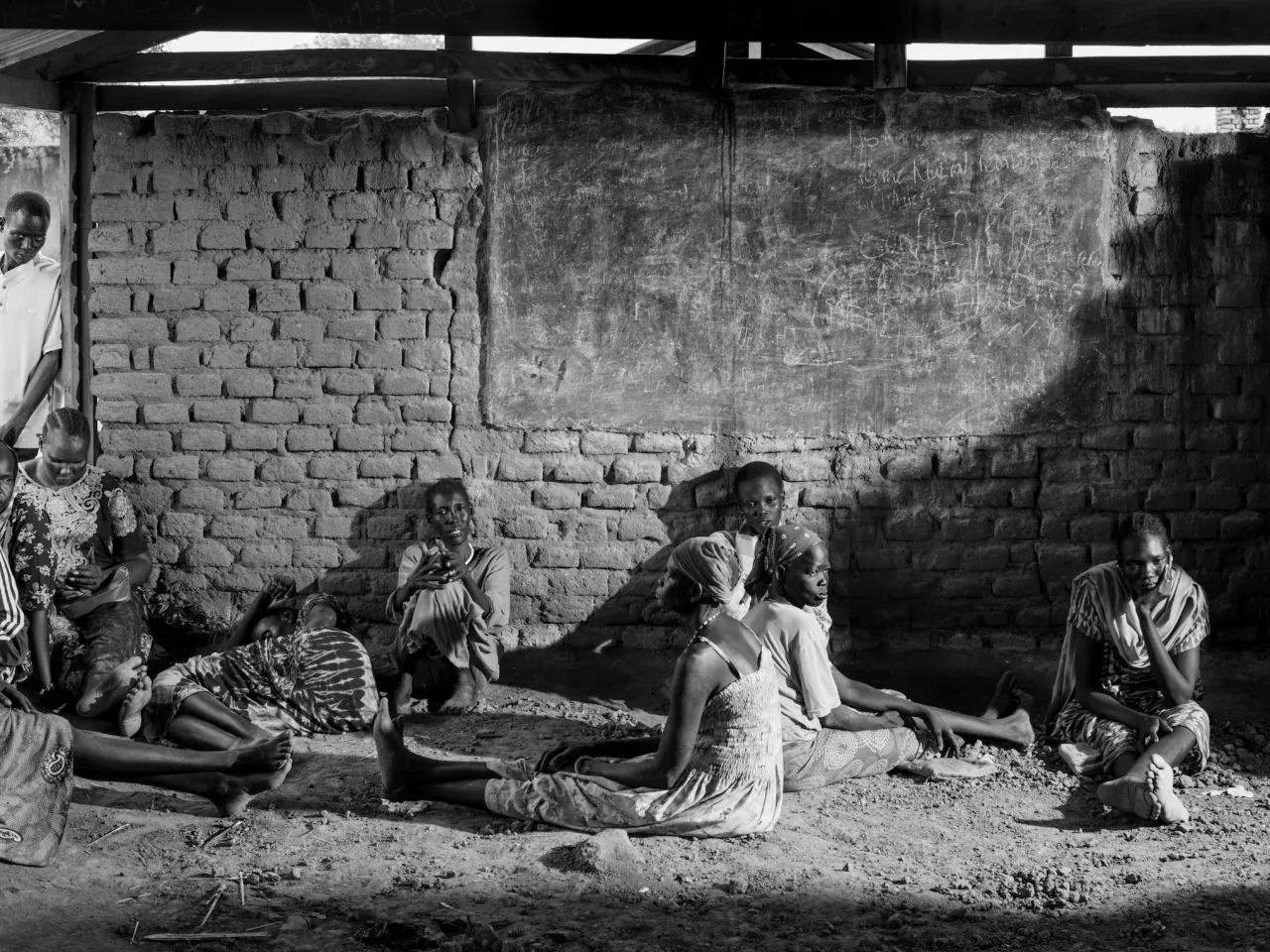

What Would You Do With No Signal and a Hungry Child?
Picture it: your youngest is four months old and needs formula tonight. You have no cash — carrying it has become dangerous, and besides, almost nobody does anymore. What you have is a balance sitting inside a banking app on your phone, and a husband working abroad who has just sent a transfer to cover it. All you need is one green checkmark.
It won’t load. The signal is gone. It has been gone for days, and nobody can tell you when it’s coming back.
This is not a hypothetical. It is the exact situation a displaced mother of four found herself in during Sudan’s second year of civil war, documented by The New Humanitarian as she stood holding her phone, watching for a notification that wouldn’t come. Her village had no pharmacy. She couldn’t walk back to her baby empty-handed. So she waited, and waited, for a piece of infrastructure that had quietly become more essential to her family’s survival than the road outside her door.
Multiply her by millions, and you start to understand what Sudan’s war has actually done to the people living through it. This is a conflict that has killed more than 150,000 people by UN estimates — a toll aid agencies believe is likely far higher, since so much of the dying happens exactly where no signal reaches. It has displaced some 14 million people, a quarter of the country, and left 33.7 million — roughly two in three Sudanese — needing humanitarian help just to make it through 2026. Nearly 20 million people are facing acute hunger. More than 800,000 children are expected to suffer severe acute malnutrition this year alone, a number 25 percent higher than before the war began. And woven invisibly through almost every one of those statistics is a second, quieter weapon: the internet switch itself, and who controls it.
A War Fought in the Dark
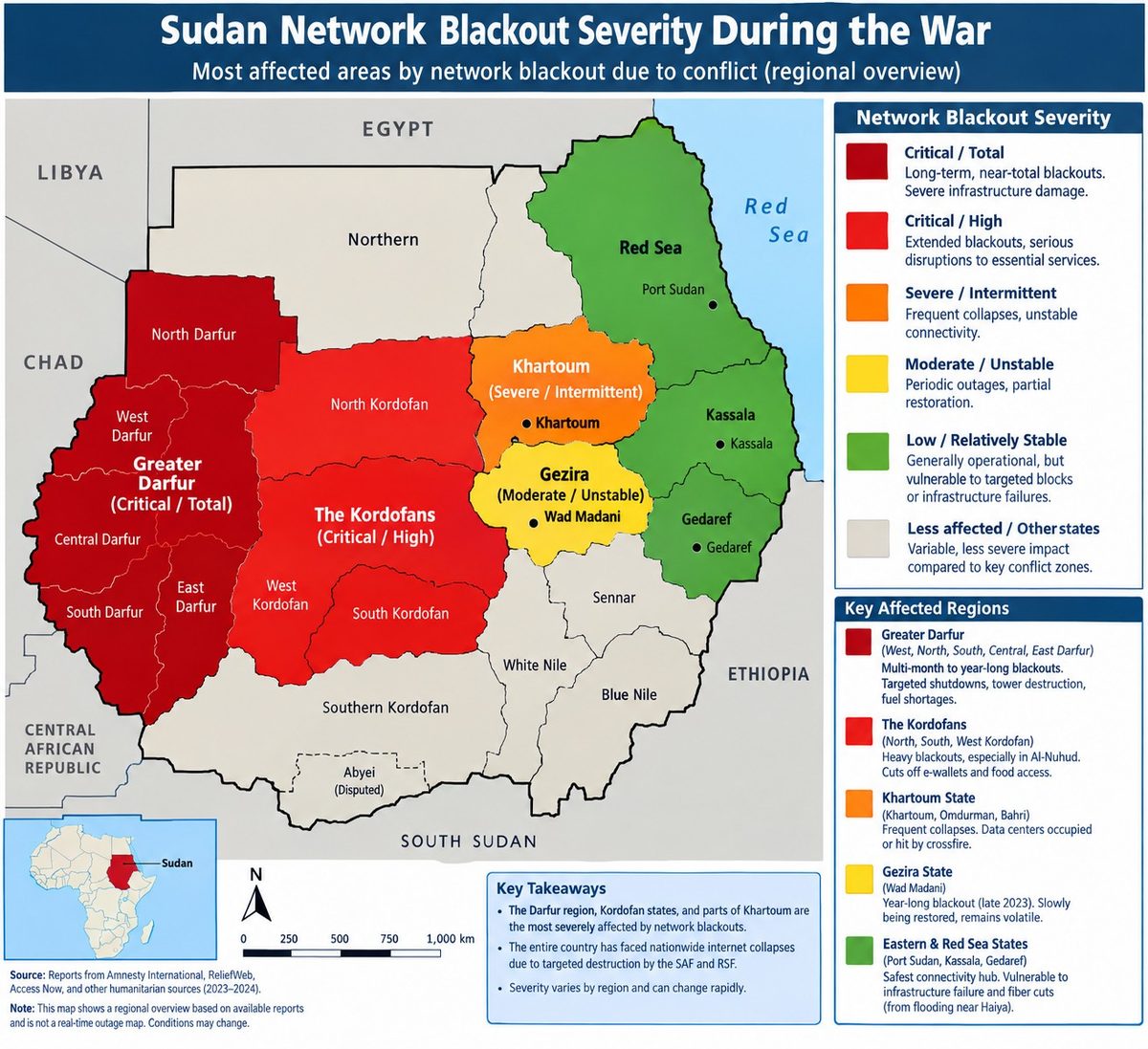
Since fighting broke out between the Sudanese Armed Forces (SAF) and the Rapid Support Forces (RSF) in April 2023, the country’s three main telecom providers — Zain, MTN and Sudani — have been shut down, sabotaged or seized so many times that NetBlocks, the internet watchdog that tracks these events in real time, has stopped treating any single blackout as exceptional. In the twelve months to 2026, Sudan logged at least 14 separate shutdowns, adding to a staggering 5,803 cumulative hours without connection since 2018. During the worst stretches, national connectivity has collapsed to as low as 44 percent of normal levels, with many users facing what NetBlocks has bluntly called a “total communications blackout.”
Each side blames the other, and the evidence suggests both are telling a partial truth. Zain Sudan’s own managing director confirmed that RSF forces physically cut the company’s communications and internet infrastructure during one major 2024 blackout. The RSF, in turn, said it was retaliating against a SAF-ordered shutdown months earlier in Darfur, territory largely under RSF control. Whatever the justification on either side, civilians caught in between experience the outcome identically: a phone that won’t connect, a bank balance that won’t move, and a world outside that stops hearing from them until someone, somewhere, decides to flip the switch back on.
The App That Became a Lifeline — and a Trap
Before the war, Sudan was edging toward a genuine fintech breakthrough. Bankak, built by the Bank of Khartoum, let people pay bills, receive salaries and collect remittances without ever touching cash. When the fighting started and the country’s physical banking system collapsed — branches looted, vaults emptied, staff scattered — Bankak didn’t stay a convenience. It became, for much of the country, the only functioning financial system left standing. App activations surged 85 percent in the first year of war alone, according to the Tahrir Institute for Middle East Policy, as millions of Sudanese who had never needed digital banking before suddenly had no alternative.
That dependence is precisely what makes the blackouts so lethal. Access Now, the digital rights group behind the global #KeepItOn campaign, has gathered testimony directly from Sudanese civilians describing what happens the instant Bankak goes dark. A pharmacist in Shendi told the organisation that when the internet cut off completely, his community was left “on the brink of starvation” — unable to buy food or medicine even with money sitting, untouched and useless, in their own accounts. Families interviewed by The Arab Weekly described falling back on barter: a hoe and a chair traded for three bags of sorghum, a refrigerator swapped for cooking fuel, because the digital money in their phones had become as inaccessible as if it had never existed.
Even when a thread of connection survives, predators fill the gap. A civil servant told The Arab Weekly that while the RSF controlled Khartoum, brokers willing to convert a Bankak transfer into physical cash took a cut of up to 25 percent — a wartime tax on the simple act of eating. In Al-Jazira Aba, residents described commissions climbing as high as 10 percent just to turn a digital balance into something a market stall would accept. Layer that on top of a country where 61.7 percent of the population — 28.9 million people — is already facing acute food shortages, and a 25 percent “convenience fee” stops being an inconvenience. It becomes the difference between dinner and nothing.
Telecom provider shut down or sabotaged
│
▼
Bankak and other banking apps go offline
│
▼
Remittances and aid payments stall mid-transfer
│
▼
Families cannot convert digital balances into food, fuel or medicine
│
▼
Meals are skipped; barter replaces currency; cash brokers charge up to 25%
The result, aid researchers warn, is a famine risk with no visible famine cause — not drought, not failed harvests, but a fibre-optic cable that someone, somewhere, chose to cut.
The Dish in the Town Square
When the ground networks fail, Starlink — Elon Musk’s satellite internet system — becomes the only alternative left. It is also, in Sudan, entirely illegal. The government banned Starlink devices outright in January 2024, treating a communications network outside state control as a threat in its own right. The ban did nothing to stop the hardware arriving. Reporting by the Wall Street Journal and AFP has traced Starlink terminals reaching Sudan through smuggling corridors running via Libya, South Sudan, Eritrea and intermediary markets in the UAE — dishes mounted on RSF pickup trucks as readily as they’re handed to desperate families fleeing the fighting.
What turns this from a workaround into something darker is what happened next: the RSF turned the last lifeline into a business. In village after village, militia members set up a single dish in the town square each morning and leave each evening “with all the money they have made,” one resident told AFP. Digital rights researcher Khattab Hamad documented an annual licence fee of roughly $830 per internet café in RSF-controlled Darfur — about a month’s average salary — paid directly to the militia for the right to resell access by the hour. In el-Gezira state, an entire town’s only route online ran through four separate RSF-run internet shops. One resident, separated from her husband working in Qatar, described walking five kilometres with her twelve-year-old son every week just to reach the dish and collect the transfer that kept them fed.
For the Norwegian Refugee Council’s Mathilde Vu, the bind facing ordinary Sudanese civilians is stark and unresolved: total dependence on a single, unregulated, militia-taxed network is a serious vulnerability — and still, for most people, there is no other option on the table at all.
Hiding the Harm
The most chilling pattern documented by human rights monitors isn’t economic at all — it’s about timing. Investigators from Access Now, Amnesty International and NetBlocks have repeatedly found that both the SAF and RSF intensify shutdowns in the hours or days immediately before major offensives, severing the very channels civilians would use to document what happens next.
Wad Madani endured one of the starkest examples: a blackout lasting roughly a year, during which reporting on the city fell almost entirely silent. Only after the army recaptured it in early 2025 did the scale of what had happened there begin to surface. More recently, during the RSF’s assault on Barah in North Kordofan in late May 2026, witnesses reported that fighters moved to seize residents’ satellite internet devices mid-attack — cutting the flow of information from a community already losing dozens of civilians, according to Sudan Tribune and Al Jazeera. A near-identical pattern has emerged around El Fasher, where a sustained Starlink blackout beginning in November 2025 lined up precisely with intensified fighting across Kordofan.
The toll of that fighting is staggering on its own terms. UN human rights officials reported that drone strikes alone killed nearly 700 civilians in the first three months of 2026 and were responsible for more than 80 percent of all civilian deaths that year — including a disproportionate share of child casualties, with UNICEF documenting at least 330 children killed or injured in the first six months of 2026. Each of those figures exists because somebody, somewhere, eventually got a signal out. For every Wad Madani and every Barah, investigators fear there are villages where no one ever did.
The People Still Watching
A small number of organisations have made tracking this blackout-by-blackout their full-time work. NetBlocks publishes near-real-time connectivity data and a public “cost of shutdown” calculator, estimating the economic toll of each outage hour by hour. Access Now’s #KeepItOn coalition has spent years collecting testimony directly from Sudanese civilians and pressing both the SAF and RSF to end what it calls a form of collective punishment. Cloudflare Radar offers an independent technical cross-check on exactly when a provider goes dark, often confirming within hours what residents are already living through on the ground.
None of these tools can restore a connection on their own. What they can do is make the blackout impossible to deny — a public, timestamped record standing against two warring parties that have, so far, faced no real consequence for switching off a country’s lifeline, again and again, for going on three years.
Sudan’s War, By the Numbers
| Indicator | Figure | Source |
| People reportedly killed in the war | 150,000+ (likely far higher) | UN / OCHA, 2026 |
| People in need of humanitarian assistance | 33.7 million (~2 in 3 Sudanese) | UN OCHA, May 2026 |
| People internally displaced or refugees abroad | ~14 million | UNHCR, 2026 |
| Population facing acute food shortages | 61.7% — 28.9 million people | 2026 Humanitarian Needs & Response Plan |
| Children expected to suffer severe acute malnutrition in 2026 | 825,000 | UN agencies, May 2026 |
| Share of civilian deaths caused by drone strikes (early 2026) | Over 80% | UN Human Rights Office |
| Surge in Bankak app activations since the war began | 85% increase | TIMEP |
| Commission some cash brokers charge to convert Bankak transfers | Up to 25% | The Arab Weekly |
| Sudan’s tracked internet shutdowns in 12 months (2026) | 14 shutdowns; 5,803 cumulative hours since 2018 | Internet Society Pulse |
| Annual RSF licence fee per Starlink-enabled café in Darfur | $500–$830 (about a month’s salary) | New Lines Magazine, Geeska |
The Weight of a Single Bar of Signal
Every blackout in Sudan carries two casualties at once: the immediate one, measured in skipped meals, stalled remittances and families reduced to bartering furniture for grain; and the hidden one, measured in whatever violence happened in the dark and was never recorded, filed, or counted among the 150,000 dead. Both are, by design, difficult to see from the outside. That is precisely the point of cutting the line in the first place.
For the mother in the displacement camp, still watching her phone for a green checkmark that wouldn’t come, the war was never an abstraction fought over territory and checkpoints. It was one bar of signal, present or absent, standing between her children and their next meal. Multiply her by a population of 48 million — a third of them now reliant on aid just to see the week out — and what looks like a technical inconvenience reveals itself as something closer to a weapon. Until the cost of silencing a country becomes too high for either side to keep paying, the switch will keep going dark, and families like hers will keep waiting for a light that may not come back on in time.
Sources: The New Humanitarian; Access Now (#KeepItOn campaign and “Internet Shutdowns in Armed Conflict” report); Amnesty International; UN News reporting on the Sudan crisis (2026)