









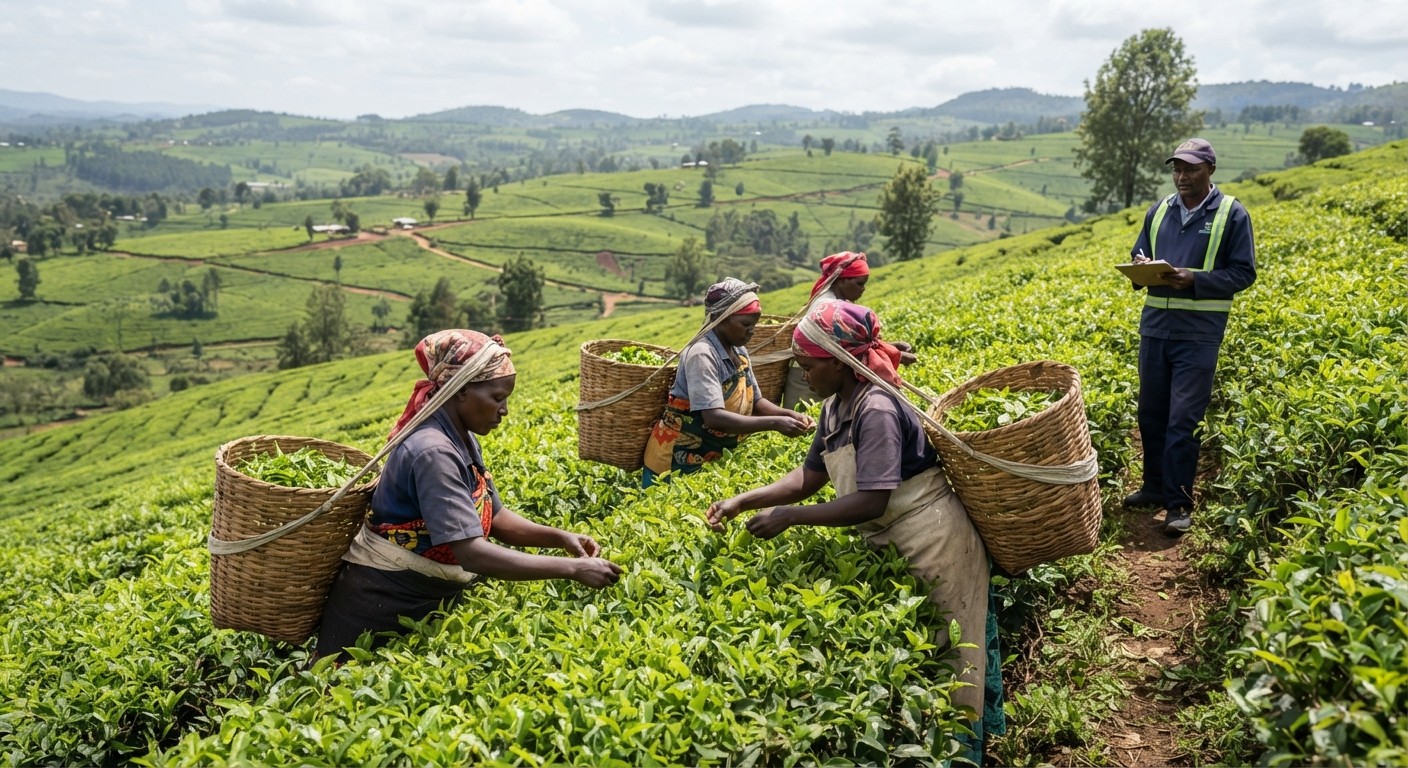

For some women who pick the world’s tea and cut its flowers, getting hired, or staying hired, has meant saying yes to a boss. Here is what has happened since the story broke, and what has not.
What does a cup of tea cost? In the highlands of Kericho, Kenya, a young woman walked into a job interview on a tea estate and was told how to get the work. The man in front of her was a contractor. The camera in her bag belonged to the BBC.
She was an undercover reporter, known on screen only as Katy. Her hidden camera, according to the BBC, showed the contractor cornering her against a window and pressing her for sex. He had the power to hire her. She did not have the power to say no and still get the job.
Katy could walk away, because she was a reporter. For thousands of real women in the tea fields, there is nowhere else to walk to.
| 100 women on tea plantations spoke to the BBC team. More than 70 alleged abuse by managers. | 22.8% of workers worldwide have faced violence or harassment at work, the ILO says. That is 743 million people. | $5 a day the average pay of women tea factory workers in one 2025 Kenyan study (about KSh 600). |
A hidden camera in the tea fields
In February 2023, BBC Africa Eye and Panorama aired “Sex for Work: The True Cost of Our Tea.” Reporter Tom Odula and his team looked at estates that, for years, belonged to two British companies, Unilever and James Finlay & Co. Between them, the BBC said, those companies had produced half the tea drunk in Britain. The tea ended up in PG Tips, Lipton and supermarket own brands sold by Sainsbury’s and Tesco, and in cups at Starbucks.
The team spoke to 100 women. More than 70 told reporters they had been abused by managers. The accounts included rape and demands for sex in return for work, in a region where jobs are scarce. Some women said they caught HIV. Others said they became pregnant. In one case, a supervisor was accused of raping a 14-year-old girl who lived on an estate. The accusation is the BBC’s reporting. The supervisor was not convicted in anything I could find.
It is just torture,” one woman said of the demands.
Woman interviewed by the BBC, February 2023
The reaction was fast. James Finlay said it had suspended and barred two contractors, including John Chebochok, and reported them to the police. The new owner of the Unilever estates, Lipton Teas and Infusions, said it had suspended two managers. Starbucks said it was very worried and stopped buying from James Finlay in Kenya. Kenya’s National Assembly ordered an inquiry, and Deputy Speaker Gladys Shollei gave MPs two weeks to finish it.
Kericho’s Woman Representative, Beatrice Kemei, who raised the matter in Parliament, said she had been reminded that “slavery still exists in this nation.” The Fairtrade Foundation went further, calling the findings a “#MeToo moment for tea.”
It was not a surprise. It was a repeat.
This is the part that should make buyers uncomfortable. The BBC reported that Unilever faced similar allegations more than ten years earlier. The company had launched a “zero tolerance” approach, a reporting system and other steps. Yet the BBC found evidence that complaints were still not being acted on.
Both firms told Kenyan MPs and reporters the same thing in different words: they did not know. Sylvia Ten Den, then Ekaterra’s managing director for Kenya, Rwanda and Tanzania, said the company had not been aware of such cases before the film. James Finlays’ corporate affairs director, Sammy Kirui, said the company had clear policies and zero tolerance. The parliamentary Labour Committee, chaired by Erick Muchangi, heard something else on its tour of Kericho. Women described managers and supervisors demanding sex for jobs, promotions and lighter work. MPs said victims were afraid to speak because they might be sacked. At James Finlay, the committee found that none of the supervisors in the vast estates were women.
Police told the committee they had arrested no one, because victims had not come forward to record statements. Women who fear for their only income do not walk into police stations. By May 2023, AFP reported that no judicial action had been taken. Weeks after the film, about 50 women reportedly served notice that they planned to sue the two companies for compensation.
The certificate question
Many farms that sell to Europe carry certificates, and shoppers trust them. After the film, the Rainforest Alliance sent auditors in. On 9 May 2023 it suspended the certification of both James Finlay Kenya and Ekaterra Tea Kenya. Its audits, it said, confirmed failures against its social and management standards. For about two months the two companies could not sell tea with the Rainforest Alliance claim. Then the suspension was lifted after new verification audits, and the group said it would keep working with both firms.
That swift reaction raises a plain question. If the abuse was as deep as women described, what were earlier audits seeing? I found no evidence that any auditor was bribed or tipped off. The more likely problem is simpler. An auditor visits for a few days. A supervisor controls a woman’s contract for months. Interviews held on the estate, with the boss nearby, are not safe interviews. Buyers, certifiers and groups like the Ethical Tea Partnership say they want to protect workers. They should now show how their checks reach a woman who is afraid to speak.
From broadcast to backlash
| Date | What happened | Result |
| 20 Feb 2023 | BBC Africa Eye and Panorama broadcast “Sex for Work” | Finlay suspends two contractors; Starbucks halts purchases from Finlay Kenya |
| Feb–Mar 2023 | National Assembly orders inquiry; Labour Committee tours Kericho | MPs hear women’s accounts; police report no arrests |
| 9 May 2023 | Rainforest Alliance suspends both estates’ certification | Lifted after about two months, after new audits |
| 28–29 Jun 2024 | Chebochok wins a KTDA factory director election in Kericho | Lipton and Finlays stop buying from the factory |
| Jul 2024 | High Court suspends his confirmation after six rights groups sue | Law Society of Kenya demands he resign |
| 6 Aug 2024 | Agriculture official Paul Ronoh says the election is annulled | Chebochok had told the court he was “condemned unheard” |
Sources: BBC, Business & Human Rights Resource Centre, Nation, Business Daily, Citizen Digital, World Tea News.
The comeback
The next chapter may be the most telling. In June 2024, John Chebochok, sacked by Finlays in 2023, ran for a seat on the board of the Tegat/Toror tea factory. It is one of the farmer-owned factories run through the Kenya Tea Development Agency, a private body that serves smallholder farmers in 16 counties. He won.
The Ethical Tea Partnership had already written to Kenya’s election body, the KTDA and the Tea Board to object. Finlays and Lipton stopped buying from the factory. Six rights groups went to court. The Law Society of Kenya said his election was alarming. The High Court paused his confirmation, and in August 2024 the agriculture ministry’s top official said the vote was annulled.
Chebochok’s side deserves a hearing. In a court affidavit he said the BBC aired its film without checking the women’s claims, and that the election body had cleared him to run. Reports also said he demanded KSh 100 million from the BBC over the film. Kenyan media and the BBC quoted these statements. I found no report of a criminal conviction against him. That is the point. A man can be sacked, filmed and shamed, and still be voted into a position of local power, because no court has ruled.
The flowers: same story, longer history
The tea scandal made headlines, but researchers have been warning about flower farms for twenty years. Kenya earned about US$835 million from flowers in 2024, according to Kenya Flower Council chief Clement Tulezi. The European Union took 70 percent of that money. Verité, a US labour-rights group, counts 127 flower farms in Kenya that employ some 90,000 people directly.
Women are the majority. A 2022 article in the Business and Human Rights Journal puts them at 65 to 75 percent of the workforce, in low-paid, unskilled jobs. Women Working Worldwide studied 62 farms in Ethiopia, Kenya, Tanzania and Uganda. It found that harassment was widespread, that many women lacked even the words to describe it, and that casual and temporary workers were most often targeted. A survey of 20 flower farms by Hivos and its partners in 2013 found that most had no workplace policy on sexual harassment, even though the law required one. Where policies existed, they were not backed by systems that worked. Women had to report to the same supervisors who were harassing them.
Around Lake Naivasha, a researcher named Lowthers wrote in the journal Signs that sex and work were so tied together that she called it an “institutionalized sexual economy.” The women often moved from other parts of Kenya to find work. Their housing was poor and their bosses held their wages. Ethiopia, which has more than 180,000 flower jobs, shows the same pattern in academic reviews.
There is progress, and it should be named. Hivos, with unions in four countries, helped write a model policy through its Women@Work programme. It has been adopted by more than 200 farms, and over 12,000 workers have been trained. Union officials say reported cases fell. That is proof the problem can be reduced when workers organise. It also shows how much remained for the farms that did nothing.
Poverty is the lock on the door
None of this works without money. A study led by Emmanuel Siakilo for the Wangu Kanja Foundation and the Coalition Against Sexual Violence, backed by Oxfam, spoke to tea workers about daily life. Factory workers earned about KSh 600 a day. Pluckers worked up to 52 hours a week against a legal limit of 45. One woman said she had worked in tea for 20 years and never been made permanent. She got three-month contracts, then was laid off, then rehired.
That is how the pressure works. A woman on a three-month contract has to please the man who renews it. The study says many companies have no clear harassment policy, and where one exists it is rarely enforced. Its authors say reporting often brings retaliation, and managers protect each other. Its blunt demand to buyers is that “ethical sourcing cannot be just a marketing slogan.”
The study also lists what the women lose. Some contract HIV or other infections. Some are beaten. Many live with anxiety and depression. And Kenya has the laws on paper. The Constitution, the Employment Act and the Sexual Offences Act all forbid it. Inspections are rare and penalties are small.
Beyond Kenya: a global pattern
Kenya is not the exception. The first global survey on work violence, run in 2021 by the ILO, Lloyd’s Register Foundation and Gallup, found that almost one in four people in work had experienced violence or harassment. Sexual violence and harassment affected 6.3 percent of respondents. Young women were twice as likely as young men to face it, and migrant women almost twice as likely as other women. Manuela Tomei, then the ILO’s assistant director-general for rights, said the findings showed people face it not once but many times in their working lives.
Tea and flower workers sit where those risks meet: young, female, often migrants, on short contracts, supervised by men, and sending a product abroad to people who will never meet them. The ILO’s Convention 190 sets a global standard against violence and harassment at work. Standards only help when someone checks them.
Who is watching the other nine in ten kilos?
One last number deserves a question. In 2024, Kenya sold tea to 96 countries, shipping 594.5 million kilograms, according to the Tea Board of Kenya. Britain bought about one kilo in ten. Pakistan bought more than a third.
Where Kenya’s tea went in 2024, by share of export volume
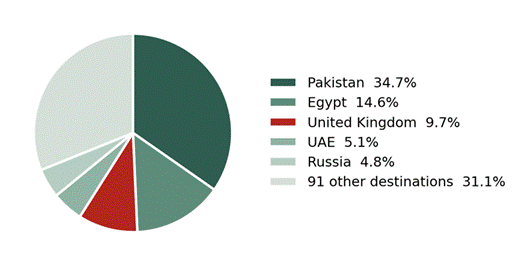
Total: 594.5 million kg. Shares calculated from Tea Board of Kenya volumes; UK volume was 57.44 million kg.
This is not proof of anything. It is a question. The scandal moved because British television caught British brands, and British shoppers, shareholders and supermarkets reacted. It is not clear that the same pressure reaches the tea that goes elsewhere. A woman’s safety should not depend on who buys the leaves she picks.
What would change it
The women, rights groups and researchers quoted here point to the same short list. Complaint channels should be run by someone other than the estate, and workers should be able to use them without telling their supervisor. Audit interviews should happen away from the farm. Casual workers who do permanent work should be made permanent, since insecure contracts are the pressure point. More women should become supervisors. Companies should publish what happened to each case, including who was fired and who was reported to the police. And buyers should treat a sacked abuser who reappears in local office as their own problem, not a local one.
Katy’s hidden camera is off now. The women are not on camera, and most do not have one. They are still in the fields at dawn, some of them holding contracts that end in three months, in an industry that has told the world it did not know.
















Comments (1)
Leakey October 4, 2026
That’s a very thought and emotion provoking piece. Great