










One TikTok comment. One WhatsApp message. One plane ticket. Across Kenya, that is now often all it takes for a job search to become a trafficking case

Digital Investigative Journalist – Kenya
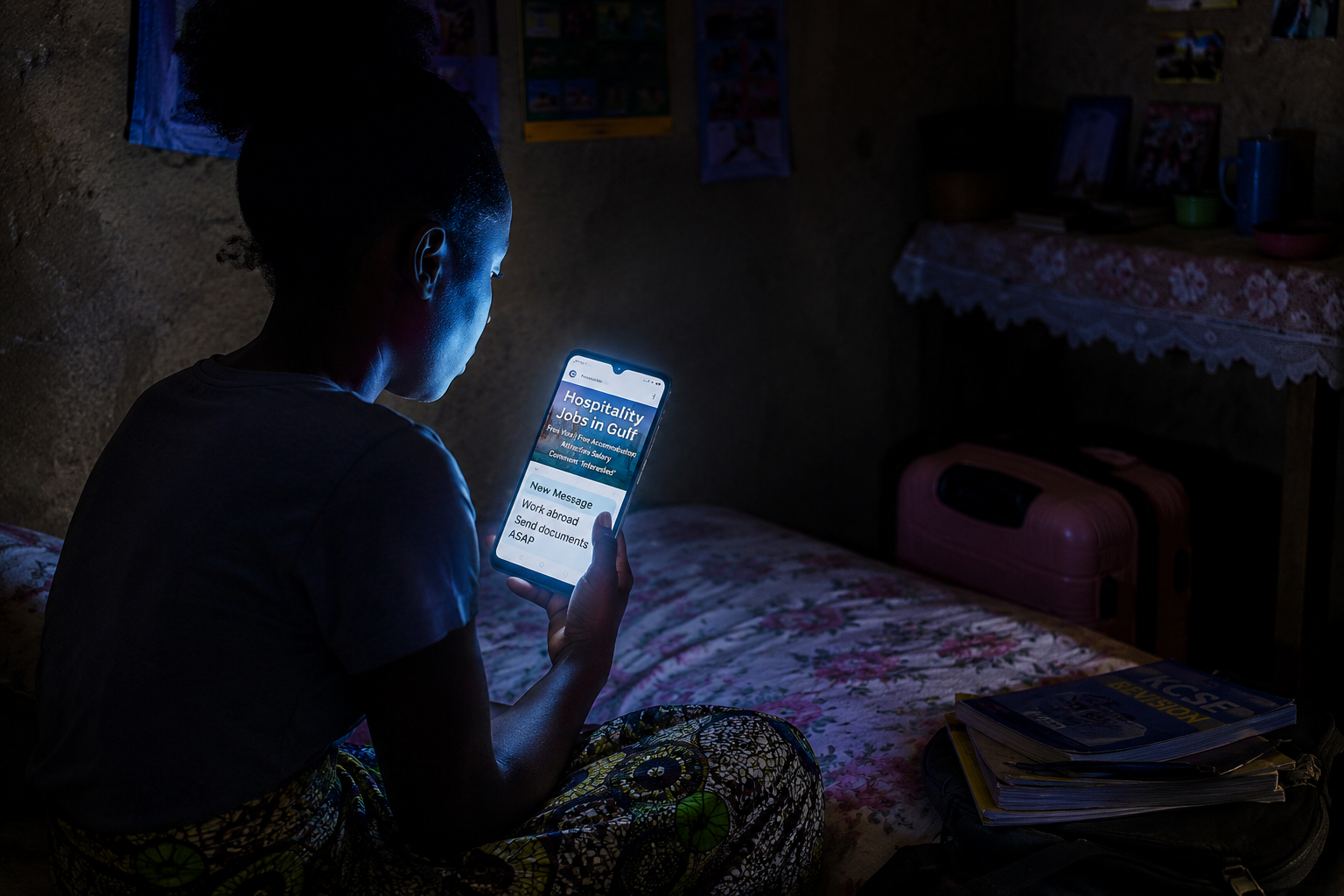
It was 11:42 p.m. when Nafula, 19, saw the advert. She was lying on her bed in western Kenya, scrolling TikTok the way she did most nights — half out of boredom, half out of habit, ever since her family couldn’t raise the fees to send her to college.
Between the comedy skits and the lifestyle videos, a well-dressed woman appeared on her screen, standing outside what looked like a luxury hotel somewhere in the Gulf. Bold text promised hospitality work, a free visa, free accommodation, a salary bigger than anything Nafula could earn at home in a year. The instructions were simple: comment “Interested” and wait.
She commented. Within minutes, a message dropped into her inbox asking her to move the conversation to WhatsApp. Over the next few days she sent her ID, her passport photos, and a mobile money “processing fee.” The recruiter kept telling her not to wait too long — the slots were “almost full.”
Nafula flew out weeks later. The job waiting for her in Oman did not exist.
What followed was months she still struggles to talk about in full: no employer, no return ticket, no one to call. She ended up living on the street, going from door to door and stranger to stranger, until one day a good Samaritan found her, listened to her story, and helped her put it on TikTok — the same platform that had sent her there in the first place. Strangers who saw the video raised money for her ticket home. The agency that recruited her, according to people who have tracked her case, is still operating.
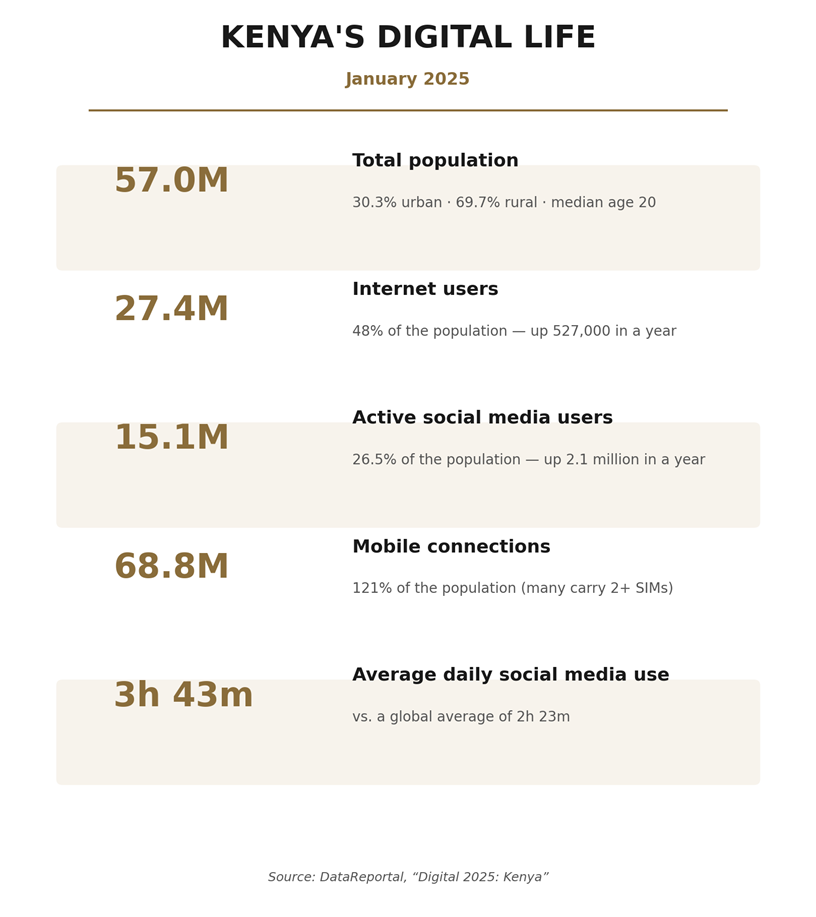
Nafula’s case is not an outlier. It fits a pattern that investigators and anti-trafficking organizations now describe with real alarm: recruitment into exploitative labour arrangements increasingly begins not in an office or a bus station, but inside a phone — in a country where, as of January 2025, 15.1 million people were active on social media and the average Kenyan spent three hours and 43 minutes a day on those platforms, well above the global average of two hours and 23 minutes.
| 15.1M Kenyans active on social media as of Jan. 2025 — up 2.1 million in a single year (DataReportal, 2025) | 44 Trafficking cases prosecuted in Kenya in 2024, more than double the 19 prosecuted in 2023 (U.S. State Dept. TIP Report, 2025) | 274 Kenyan migrant workers, mostly women, reported dead in Saudi Arabia over the past five years (TIP Report, 2025) |
Sources: DataReportal, Digital 2025: Kenya; U.S. Department of State, 2025 Trafficking in Persons Report.
According to the International Labour Organization and the United Nations Office on Drugs and Crime, traffickers now use digital technology throughout the entire recruitment pipeline — identifying targets on social media, moving conversations to encrypted apps, arranging payments electronically. Globally, forced labour generates an estimated $236 billion in illicit revenue a year, trapping an estimated 17.4 million people in agriculture, construction, domestic work and manufacturing, according to figures cited in the 2025 Trafficking in Persons Report.
In Kenya, licensed labour migration agencies are required to register with the National Employment Authority, and government agencies have repeatedly warned the public against paying recruitment fees to individuals operating exclusively through social media.
Yet fraudulent job advertisements continue to circulate online, often using stolen company logos, fabricated testimonials and promises of unusually high salaries to build credibility before directing applicants to private messaging platforms.
The scale of the risk is stark: media investigations cited in the State Department’s 2025 report found that at least 274 Kenyan migrant workers, most of them women, died in Saudi Arabia over the past five years — including at least 55 in 2024 alone, twice the toll recorded the year before. The same report describes recruitment websites that treat female domestic workers “akin to household goods sold by retailers online,” with some listings displaying workers’ photos alongside an “add to cart” function.
“Many young people believe that if an advertisement has thousands of views, hundreds of comments and professionally designed graphics, it must be genuine. Unfortunately, popularity on social media is not evidence of legitimacy.”
Easter Achieng, Executive Director, Kenya Female Advisory Organization (KEFEADO)
As governments strengthen traditional border controls and labour migration regulations, traffickers are adapting to a new frontier — one that exists not at immigration checkpoints, but inside the smartphones carried by 68.8 million active mobile connections in Kenya, a figure that now exceeds the country’s entire population of 57 million because so many people carry more than one SIM card.
A Trail of Names
Nafula got to come home. Not everyone does.
Caroline Wanjiru was 27 when she left for Saudi Arabia on January 17, 2023, hoping to save enough working as a domestic helper to build her mother a house. She hid her travel plans until three days before her flight, knowing her mother would object. She died there. Her mother later told a Kenyan reporter that both the government and the recruitment agency that sent her daughter abroad had failed her.
Pauline Muthoni Njuguna made it home — but not in time. She fled her Saudi employer’s house without her passport after falling seriously ill and being denied care, was diagnosed with stomach cancer, and underwent surgery under a false name because she feared being sent back. When she finally reached Kenya in 2021, doctors at Kenyatta University Hospital discovered she was missing a kidney. She died months later.
Eunice Njenga spent more than two years in Saudi Arabia starting in 2019, cycling through eight different households, living on a poor diet and little sleep. Margaret Mutheu Mueni endured starvation and had her passport confiscated by her employer. A domestic worker identified as Selestine escaped her household when the mistreatment became unbearable and was flown home only after an international rescue organization intervened.
Amnesty International interviewed 70 Kenyan women who had worked as domestic staff in Saudi Arabia and documented a common pattern: 16-hour days with no rest, wages as low as 900 riyals (about $240) a month — roughly 50 cents an hour — and employers who withheld pay entirely.
Kenya now has an estimated 150,000 domestic workers in Saudi Arabia alone, part of a labour pipeline the government has actively encouraged as unemployment climbs and remittances become one of the country’s largest sources of foreign income.
“What I can say is that both failed me.”
A mother, referring to the Kenyan government and the recruitment agency that sent her late daughter abroad — The Star, 2026
Kenyan advocates describe what’s happening as a “systematic chain of trafficking” that starts long before anyone boards a plane — built on debt bondage, with recruitment fees running Sh80,000 to Sh150,000 that workers are told to pay back out of wages they haven’t yet earned. Those who recruit are often not strangers at all, but friends, neighbours or relatives who repeat a story someone told them.
A Village, a Piece of Land
Not every recruiter works through a screen first. Sometimes the phone comes later.
A young woman we are identifying only as Chebet, from a village in Kenya’s Rift Valley, was walking to the market when a woman approached her and asked whether she had a job. She said no.
“She told me they train and take people to Dubai for cleaning jobs, security, cashiers and more. She gave me her number and I reached out to her.”
Chebet, describing how she was first approached — name changed for her protection
To pay the fees the recruiter demanded, Chebet convinced her mother to sell the only piece of land the family owned. It was meant to be an investment in her daughter’s future. Instead, Chebet was mistreated once she arrived in Dubai and, she says, raped. She came home sick, with nothing to show for the land that had been sold to send her.
“I regret doing that, and one day I will live to tell this story.”
Chebet
Her case has not been prosecuted. There is no public record of the agency that recruited her, and no compensation has reached her family for the land they lost. Advocates who work with survivors say that is typical: most recruitment happens through informal, undocumented brokers who leave no paper trail, and most families never see any of the money — or the land — again.
When Regulation Struggles to Keep Pace
The growth of online recruitment has exposed a challenge that regulators across East Africa are still trying to address. While labour laws and licensing requirements were designed to oversee physical recruitment agencies, much of today’s fraudulent recruitment activity begins online, often crossing multiple digital platforms before authorities become aware of it.
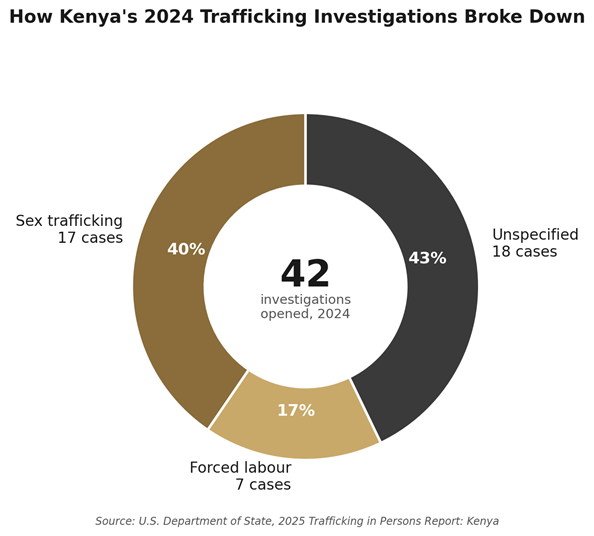
Kenya’s own record shows both the scale of the response and its limits. The U.S. State Department’s 2025 Trafficking in Persons Report kept Kenya at Tier 2 — meaning the government does not yet fully meet the minimum standards for eliminating trafficking but is making significant efforts to do so. In 2024, Kenyan authorities opened 42 new trafficking investigations — 17 for sex trafficking, seven for forced labour and 18 for unspecified forms of trafficking — compared with 22 investigations in 2023, and had 83 cases still open. Prosecutors filed 44 trafficking cases in 2024, more than double the 19 filed the year before, and courts convicted at least 21 traffickers, up from just three in 2023. Two labour traffickers were sentenced to 30 years in prison; one sex trafficker received 20 years and a fine, another 10 years and a fine.
Kenya’s Anti-Trafficking Enforcement, 2023 Vs. 2024
| Metric | 2023 | 2024 | Change |
| Investigations opened | 22 | 42 | +91% |
| Cases prosecuted | 19 | 44 | +132% |
| Traffickers convicted | 3 | 21 | +600% |
Source: U.S. Department of State, 2025 Trafficking in Persons Report: Kenya.
Corruption remains a persistent obstacle. In February 2024, an interagency law enforcement team arrested four police officers allegedly complicit in a trafficking case involving 37 potential Ethiopian victims moving through Kenya — one of several incidents cited by investigators as evidence that some officials continue to accept bribes to warn traffickers of pending operations, particularly along the coast.
Officials acknowledge that the shift online has complicated enforcement. A social media account promoting overseas jobs may be created in one jurisdiction, managed from another, and target job seekers across several countries simultaneously. By the time complaints are received, investigators may be dealing with deleted accounts, inactive phone numbers or digital records that require cooperation from multiple agencies to access.
The National Employment Authority says it continues to inspect and license agencies recruiting Kenyans for overseas employment while advising the public to verify recruiters before accepting offers or paying any fees. The authority has also urged job seekers to report suspicious advertisements and use its official register to confirm whether an agency is legally authorized to operate.
Technology companies have introduced policies intended to combat scams and deceptive content, but researchers say enforcement remains uneven. Fraudulent accounts can be reported and removed, yet similar profiles often reappear using different usernames, profile photographs or contact numbers — a game of whack-a-mole made easier by the sheer scale of the platforms involved: TikTok alone reported 15.1 million adult users in Kenya at the start of 2025, a 42.7 percent jump in a single year, according to DataReportal.
The Economics Behind the Bait
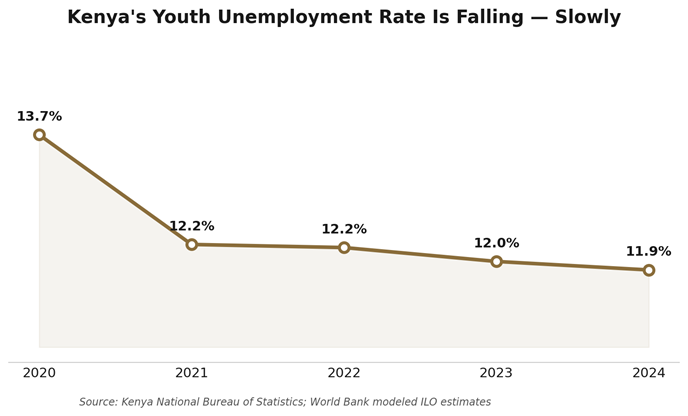
Labour rights advocates point to the broader economic context driving young Kenyans toward risky offers. Kenya’s youth unemployment rate stood at 11.9 percent in 2024, according to the Kenya National Bureau of Statistics, down only marginally from 12.01 percent the year before.
The Federation of Kenya Employers estimates that more than a million young people enter the labour market every year with no formal skills, competing for a shrinking pool of formal jobs; the KNBS 2024 Economic Survey found that roughly 83 percent of all employment in Kenya is now informal, offering little security and no legal recourse when a recruitment promise turns out to be a scam.
Persistent unemployment, rising living costs and limited formal employment opportunities continue to push many young people to search for work beyond Kenya’s borders. Criminal networks exploit these pressures by presenting overseas employment as a quick solution, often disguising fraudulent recruitment behind professionally branded online campaigns that borrow the visual language of legitimate agencies.
Closing the Gaps
For survivors, escaping exploitation is often only the beginning of a much longer recovery. Many return home carrying financial losses, psychological trauma and the stigma of failed migration. Families that borrowed money to finance overseas travel may be left with debts they cannot repay, while victims often struggle to rebuild trust after being deceived by promises of legitimate employment.
Kenya’s government has moved to formalize victim support. In 2024 it launched formal guidelines for its National Assistance Trust Fund for Assisting Victims of Trafficking; for the 2024–2025 fiscal year, the National Treasury allocated 20 million Kenyan shillings (about $155,220) to the fund — the same amount budgeted in each of the two previous years.
Organizations that support survivors say reintegration requires more than emergency assistance: access to counselling, legal support, vocational training and economic opportunities that reduce the pressure to migrate again under unsafe conditions. Without those interventions, experts warn, some survivors remain vulnerable to repeated exploitation.
Opportunity Should Never Become Exploitation
For thousands of young people across East Africa, social media has transformed the search for employment. It has connected job seekers to legitimate opportunities, opened access to international labour markets and expanded professional networks in ways that were unimaginable a generation ago.
Yet the same digital tools have been exploited by criminal networks seeking to profit from economic hardship and limited employment opportunities. As recruitment increasingly shifts from physical offices to smartphones — and as Kenya adds social media users faster than almost any other East African market — the responsibility to protect vulnerable job seekers must evolve as well.
For the young woman whose late-night search for work began this investigation, the lesson came at a high cost. For many others, the next recruitment message may already be appearing on their screen.
Whether it leads to opportunity or exploitation may depend not only on the choices they make, but on how effectively governments, technology companies and society respond to an increasingly digital form of recruitment that respects no borders.