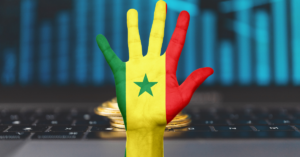





A viral deepfake didn’t wait for chaos in Senegal — it manufactured its own, days after one of Africa’s most celebrated peaceful elections. From Kenya’s 2022 vote to Sudan’s collapsed transition, disinformation campaigns across the continent have nearly quadrupled in a year. This investigation traces five countries, five patterns, and one uncomfortable question: can democracy survive the deepfake?
Days after Senegal’s March 2024 presidential election — one of the continent’s rare, celebrated democratic transitions — a video began circulating on TikTok, X, and WhatsApp. It showed the country’s new 44-year-old president, Bassirou Diomaye Faye, delivering a searing rebuke of France, Senegal’s former colonial ruler. Within days it had drawn well over a million views.
There was just one problem: Faye never said any of it. Fact-checkers traced the footage to a real 2021 press conference given by a different politician — Ousmane Sonko, Faye’s mentor and soon-to-be prime minister — who had spoken in French, not the fluent English heard in the viral clip. Investigators found the video didn’t just mistranslate Sonko’s words; it invented far more of them than he’d ever spoken. Two years later, in May 2026, fact-checkers in the region caught a follow-up: a fabricated clip of Faye “firing” Sonko as prime minister, its audio rated as entirely AI-generated by detection tools, paired with a second fake clip staging Sonko’s reaction to his own invented dismissal.
Senegal hadn’t just voted peacefully. It had proven that peace is no defense. If anything, a calm transition made a more convincing canvas for fabrication than chaos would have.
That is the uncomfortable pattern now emerging across the continent. Synthetic media, coordinated bot networks, and old-fashioned rumor-mongering — increasingly working in concert — are no longer just amplifying political tension in fragile states. They are actively manufacturing it, in countries with every reason to expect stability.

Five countries at the center of Africa’s disinformation crisis
A Continent-Wide Surge
The scale is no longer speculative. The Africa Center for Strategic Studies, a U.S. Department of Defense-affiliated research institution, documented 189 distinct disinformation campaigns across Africa in 2023 — nearly four times the number recorded just a year earlier, and researchers believe even that figure understates the real total given how difficult these campaigns are to detect. West Africa alone accounted for roughly 40 percent of them, prompting one Ghanaian media executive to call the region the continent’s disinformation “epicenter.”
Who’s behind it matters. The same research found that roughly six in ten documented campaigns are foreign-sponsored, disproportionately aimed at propping up authoritarian governments and military juntas rather than at any particular election outcome. Two Russia-linked influencers tracked by researchers commanded a combined social media following exceeding 28 million people, amplified daily by networks of coordinated accounts. Internet penetration across the continent varies wildly — from just 7 percent in the Central African Republic to 51 percent in Nigeria — a gap that shapes not just how disinformation spreads, but who has any chance of encountering a correction.

Documented disinformation campaigns in Africa nearly quadrupled in one year
Kenya: The Trial Run
Kenya’s 2022 general election has become something of a template for what comes next elsewhere. A Mozilla Foundation researcher identified 130 TikTok videos pushing disinformation and ethnically inflammatory content in the run-up to the vote. False claims that candidates had already won circulated before results were final, alongside fabricated reports of military deployments in Nairobi and rumors that election officials had miscounted votes.
The country’s electoral commission became a target in its own right. Its chairman said there were repeated attempts to improperly access the official form used to declare the presidential winner, and a forensic review later found unauthorized parties had accessed the commission’s data-transmission servers. One Kenyan study found that while nearly half of social-media users rely on the platforms as a news source, three-quarters of them cannot reliably tell real news from fake.
What kept Kenya from tipping into wider violence, researchers say, was not luck but preparation: a UN-backed project linking national and local peacebuilding actors improved early-warning systems before the vote, while platforms including Meta worked to pull down false content in real time. It’s a rare example of a country’s institutions outrunning the disinformation aimed at them — though barely.
Nigeria: Fabricated Endorsements, Real Money
Nigeria’s 2023 elections showed how disinformation now has a functioning marketplace behind it. A coalition of a dozen fact-checking organizations — including Africa Check, DUBAWA, and Premium Times, working from live “situation rooms” in Lagos and Abuja — fact-checked 127 distinct claims across the presidential and state elections.
Some of the year’s most damaging falsehoods involved fabricated endorsements. Quotes were falsely attributed to former president Olusegun Obasanjo suggesting he’d backed a specific candidate; Nobel laureate Wole Soyinka was misrepresented as endorsing another. Investigators also documented a leap in the sophistication of manipulated audio, with fake recordings constructing entire invented conversations between politicians.
Behind much of it was cash. A BBC investigation found Nigerian politicians secretly paid social-media influencers as much as 20 million naira — roughly $43,000 — to spread disinformation about their opponents, with some of those same influencers later recruited into monitoring teams meant to catch the very content they’d helped create. Mozilla’s senior elections researcher, Odanga Madung, told Al Jazeera the patterns closely mirrored what he’d seen in Kenya the year before, and that misinformation “affects the level at which people turn up to vote.”
Nigerian politicians secretly paid influencers up to $43,000 to spread disinformation about their opponents
Côte d’Ivoire: Stability as a Target
If Kenya and Nigeria show disinformation exploiting existing volatility, Côte d’Ivoire’s 2025 presidential election shows something more unsettling: a country targeted precisely because of its stability. Long regarded as a rare bastion of steady economic growth in West Africa, it drew the attention of Russian-linked and Russian-trained disinformation networks — some reportedly operating out of neighboring, junta-led Burkina Faso — in the run-up to an October vote already tense over the disqualification of two prominent opposition candidates.
In August 2025, accounts with tens of thousands of followers spread false reports of violent unrest in Abidjan during what were, in fact, peaceful protests against President Alassane Ouattara’s bid for a fourth term. The country’s own cybersecurity agency said the accounts were trying to fabricate the appearance of an insurrection. Months earlier, the BBC’s disinformation unit traced a viral fake coup rumor to a Burkina Faso-based activist with 200,000 TikTok followers, who paired a call for Ivorian soldiers to revolt with combat footage that had nothing to do with Côte d’Ivoire — it was actually unrelated footage from tensions between India and Pakistan.
The stakes are not abstract. Côte d’Ivoire’s disputed 2010 election triggered clashes that killed more than 3,000 people, a trauma that still shapes how combustible online rumors can become offline.
Sudan: Disinformation as a Weapon Against Transition
Sudan offers the starkest case of disinformation not just distorting an election, but helping prevent one from ever succeeding. In the lead-up to the 2019 uprising that toppled Omar al-Bashir, his government’s “Cyber Jihad Unit” monitored dissent and spread disinformation painting protesters as violent. After his fall, a Facebook-linked propaganda network reaching more than 450,000 followers worked to promote the military and undermine the civilian-led transitional government that replaced him — activity a Carnegie Endowment report tied to Russian influence operations.
The pattern repeated ahead of the October 2021 military coup: a Sudanese digital-media outlet documented at least 20 distinct propaganda campaigns in the weeks beforehand, designed to turn public opinion against the transitional government and toward military intervention. A UK-based analysis of tweets using a pro-military hashtag found the most active five percent of accounts bore classic markers of coordinated bot activity. After the coup, Sudan’s military factions reportedly spent $6 million Canadian on an international PR campaign, then partnered with an Egyptian firm to staff pro-military troll operations — infrastructure that has only expanded since civil war broke out between rival military factions in 2023.
In Sudan, disinformation didn’t just distort a transition to democracy — it helped prevent one from ever succeeding
Senegal: When a Peaceful Election Becomes the Target
Not every case fits the pattern of exploiting existing instability. Senegal’s March 2024 election was, by most accounts, a genuine democratic success — a peaceful transfer of power that made 44-year-old Bassirou Diomaye Faye Africa’s youngest elected head of state. Days later, a video went viral showing him delivering a blistering anti-France speech in fluent English. It collected well over a million views before fact-checkers traced it to a real 2021 speech given not by Faye, but by his mentor and future prime minister, Ousmane Sonko — who had spoken in French, and said considerably less than the fabricated English version put in his mouth.
The pattern didn’t stop there. In May 2026, a second wave of fabricated videos surfaced: one showing Faye supposedly announcing Sonko’s dismissal as prime minister, its voice rated as entirely AI-generated by detection tools, followed by a fake “reaction” clip of Sonko responding to his own invented firing.

The Senegal deepfakes escalated over two years
The lesson here cuts against the usual narrative. Deepfakes don’t need chaos to work — a calm, credible transition can be just as useful a canvas, because the audience has no instinct to doubt what it’s seeing.
Senegal hadn’t just voted peacefully. It had proven that peace is no defense.
The Bigger Question
None of these countries fit the same profile. Kenya and Nigeria are democracies with combative but functioning electoral institutions. Côte d’Ivoire is a rare economic success story. Senegal, until recently, was Exhibit A for African democratic resilience. Sudan is the cautionary tale of what happens when disinformation wins.
Senegal complicates the picture further: it shows the tactic no longer needs a fragile state at all, just a popular new leader and an audience eager to believe good news. What links all five cases is that none of it required much: a laptop, an AI voice-cloning tool, a network of accounts willing to amplify, and a well-timed release. The Africa Center’s own researchers admit their documented total — 189 campaigns in a single year — is almost certainly an undercount, because so much of this activity is deliberately built to look like nothing at all.
So, can democracy survive the deepfake? The early evidence suggests it can — but only where institutions, fact-checkers, and platforms move roughly as fast as the fabrications do. In Kenya, that combination helped avert wider violence. In Sudan, its absence helped hand power to the generals. The gap between those two outcomes may be the single most important story in African politics over the next decade.