






Halima adjusts the tarp over her shack in Eastleigh, checking it for leaks before the evening rain. It is an odd kind of fear for a woman who spent most of her life praying for rain. Back home, near Baidoa, water was the thing that never came. Here, it is the thing that finds every gap in a roof made of salvaged iron sheets and plastic sheeting. She has learned to read this new climate the way she once read the old one — for threats, not blessings.
“We had forty-two goats and eleven cows when the rains failed the second year in a row. By the third dry season, we were down to six goats. The morning my last cow died, my husband didn’t speak for three days. That’s when I knew,” Says Halima.
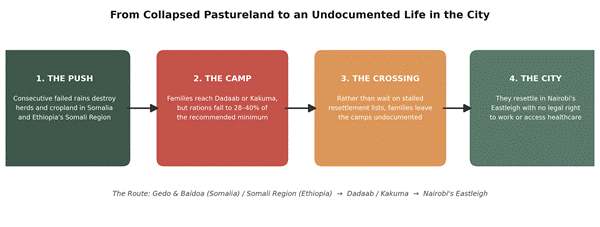
Halima’s family is one of an unknown but growing number of households from Somalia and Ethiopia who are bypassing Kenya’s official refugee system entirely, moving straight from drought-stricken pastoral land into the dense, informal economy of Nairobi’s Eastleigh neighbourhood. They arrive with no camp registration, no alien identification card, and — under Kenyan and international law — no formal recognition as refugees at all, because the law does not yet have a category for people displaced by climate rather than conflict.
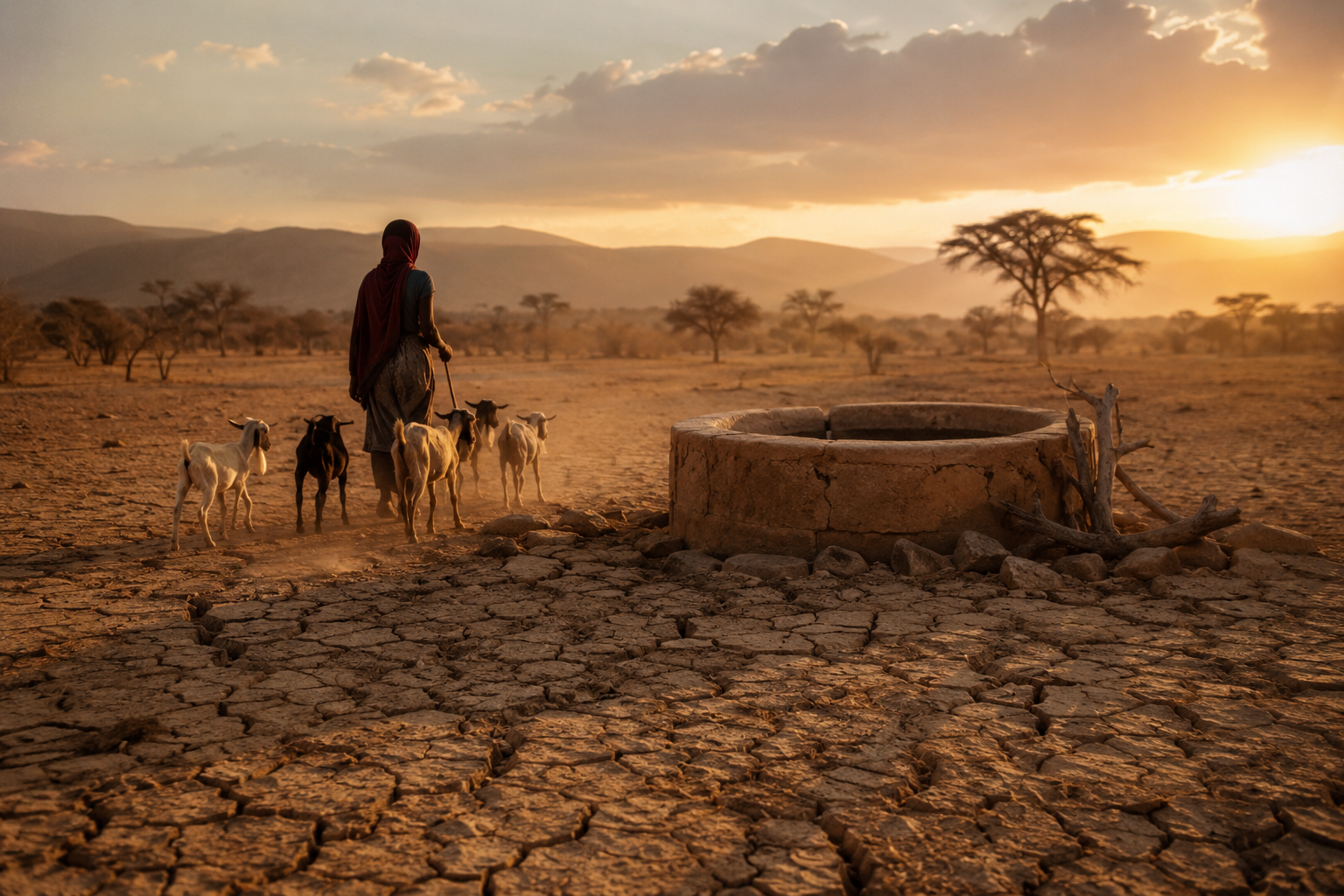
The scale of the crisis behind her decision is difficult to overstate. Regional humanitarian agencies estimate that between roughly 24.5 and 25.9 million people across Somalia, Kenya, and Ethiopia currently require urgent food assistance amid a fresh wave of severe drought. European drought-monitoring data has flagged record-low soil moisture and unusually high temperatures across the Gedo and Baidoa regions of Somalia and the southeastern lowlands of Ethiopia — the same corridor Halima and her neighbours come from. Somalia alone is estimated to have lost more than 1.4 million livestock to the drought.
For pastoralist families, livestock is not simply property; it is the entire economic and social architecture of a household. Abdi, 27, from the Somali region of Ethiopia, watched that architecture collapse harvest by harvest.
“Three harvests failed. The last one gave us maybe two sacks of sorghum where we used to fill twenty. My father wouldn’t leave the land even as our herd dropped from around sixty camels and goats combined to under ten. I made the decision alone, honestly — for my younger siblings.” Did he feel he had a choice? “Not really,” he says. “By the time I decided, there was almost nothing left to decide about,” Abdi Narrates.
Further south, Fatuma, 51, a matriarch who eventually passed through Kakuma before reaching Eastleigh, no longer keeps exact figures.
“I don’t have exact numbers anymore — I lost count of the goats as they died one by one over two seasons. What I remember is the smell of the empty pen, and my husband’s silence. No woman with five children and no water has a choice,” Fatuma Added.
None of the three describe fleeing violence. They describe fleeing a landscape that stopped supporting life. “The land made the decision,” Halima says. “You can’t farm dust.”
| Interviewee | Origin | Livestock Before | Livestock After | Trigger to Leave |
| Halima, 34 | Near Baidoa, Somalia | 42 goats, 11 cows | 6 goats, 0 cows | Death of last remaining cow |
| Abdi, 27 | Somali Region, Ethiopia | ~60 camels & goats combined | Under 10 | Third consecutive failed harvest |
| Fatuma, 51 | Rural Somalia (via Kakuma) | Untracked; lost gradually | Effectively none | Eldest child fell ill, no medicine at camp clinic |
What pushed each family beyond the point of return, however, was not the drought alone but what happened after they reached the camps meant to shelter them. Conventional refugee policy assumes that displaced families will move toward, not away from, Kenya’s two major camp complexes — Dadaab and Kakuma, which together are estimated to shelter more than 740,000 registered refugees. But interviews and aid-agency reporting increasingly describe the camps as a way station families are actively fleeing, not a destination.
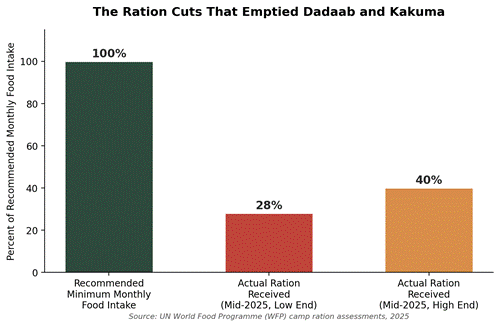
The core driver is hunger inside the camps themselves. International donor shortfalls have forced repeated cuts to emergency food rations distributed by the UN’s World Food Programme, and by some assessments, refugees in the camps were by mid-2025 receiving as little as 28 to 40 percent of the recommended minimum monthly food intake, with supplementary feeding for vulnerable groups suspended in places.
“We got maize, oil, and beans once a month — supposed to last thirty days, lasted maybe eighteen. My youngest developed a cough that never fully left. We sold what little we had for the fare and left without registering the move,” Says Halima.
Abdi also added, “An outbreak of illness in the camp block next to ours. I decided I wasn’t going to watch my sisters get sick waiting for a resettlement list that never moved.”
“My oldest fell ill and the clinic had no medicine. That night I decided we were going, papers or no papers,” narrates Fatuma.
All three describe the camps not as failures of shelter, but as failures of sustenance and momentum — food that doesn’t last the month, registration and resettlement processes that don’t move, and a rising sense that waiting itself had become the danger.
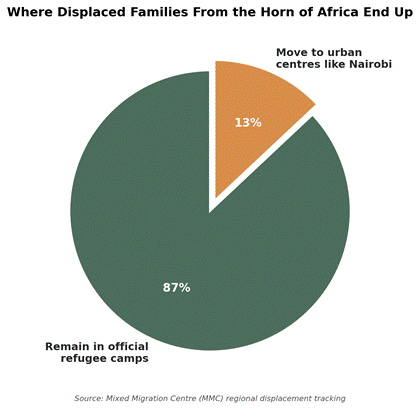
Once in Nairobi, families exchange one set of risks for another. Most displaced people in the region still end up in camps; only a minority — regional migration researchers put the figure at roughly 13 percent — choose urban centres like Nairobi instead. But Kenya has long maintained a strict de facto encampment policy, and even where legal reforms under the Department of Refugee Services have opened a path to urban registration, in practice it remains notoriously difficult to secure. The result is a population of undocumented urban migrants who have no legal right to work, no guaranteed access to free healthcare, and no protection from extortion by local authorities, because they lack the alien identity cards that would make their presence official.
Halima: “I keep my head down, I dress like I’ve always lived here, I avoid main roads when there are police checks.”
“I speak Somali well enough to pass, I work informally, I never carry anything that could get lost or stolen since I have no ID to replace it with,” Says Abdi.
“I hide it by belonging to everything around me — the market, the mosque, the neighbour,” Added Fatuma.
Legal aid organisations working inside Eastleigh, including the Refugee Consortium of Kenya, have published policy analysis specifically on the gap between climate displacement and existing refugee law, arguing that current regional frameworks were built around conflict-driven displacement and simply do not contemplate people who move because the land beneath them stopped producing. Without that legal recognition, families like Halima’s, Abdi’s, and Fatuma’s remain classified — and policed — as undocumented economic migrants, rather than as people responding to an environmental catastrophe that no one disputes is real.
| Official Refugee System (Camps) | Undocumented Urban Reality (Eastleigh) | |
| Legal status | Registered, but rations and services declining | No legal recognition as refugee or migrant |
| Food access | ~28–40% of recommended minimum (2025) | Dependent entirely on informal income |
| Right to work | Restricted by encampment policy | None — all work is informal and unprotected |
| Healthcare | Limited, camp clinics under-supplied | No guaranteed access; avoided to prevent exposure |
| Primary risk | Malnutrition, stalled resettlement | Arrest, extortion, exploitation by landlords |
It is tempting to read this migration as a single, linear story: drought pushes families out, camps fail to hold them, cities absorb them badly. The reality inside Eastleigh is messier and more human than that arc suggests — a matriarch rebuilding a support network out of a mosque and a market stall, a young man who made an irreversible decision “alone, honestly,” a mother who still measures her new life against a well she can picture exactly, rope-length by rope-length.
Halima: “You write about ‘displacement’ like it’s a weather report. It’s my children’s whole future. We didn’t come here to disappear. We came here to survive.”
Abdi: “We’re not statistics on a spreadsheet. Every number is someone’s whole life restarting from nothing.”
Fatuma: “You see borders. We see our children’s survival. That’s the whole difference.”
That gap — between the administrative categories governments and agencies use to manage displacement, and the lived reality of families who fall outside every one of those categories — is the real subject of this story. Somalia, Ethiopia, and Kenya have no cohesive cross-border policy for people displaced specifically by climate collapse rather than conflict, which means Halima, Abdi, and Fatuma exist in a legal vacuum entirely of policy’s making, not their own. Until that vacuum is addressed, families will keep making the same calculation Halima’s husband made in silence over three days: that a life without documents in Nairobi is still safer than a life with no water at all.
Sources: Oxfam regional food security assessments; European Commission Global Drought Observatory (GDO); UNHCR Kenya Operational Updates; UN World Food Programme (WFP) ration assessments; Mixed Migration Centre (MMC); Refugee Consortium of Kenya (RCK) policy briefs; first-hand interviews with displaced families in Eastleigh, Nairobi.