









How many of the 473 unclaimed bodies that filled Nairobi’s main public mortuary beyond capacity in 2026 ever had their fingerprints run through Kenya’s national database?
That question has no public answer.
For months I followed a trail of official notices, county statements and legal documents that record one of the largest single disposal exercises of unclaimed bodies in Nairobi in recent years. What the records show is clear. What they refuse to show is equally revealing.
The August notices
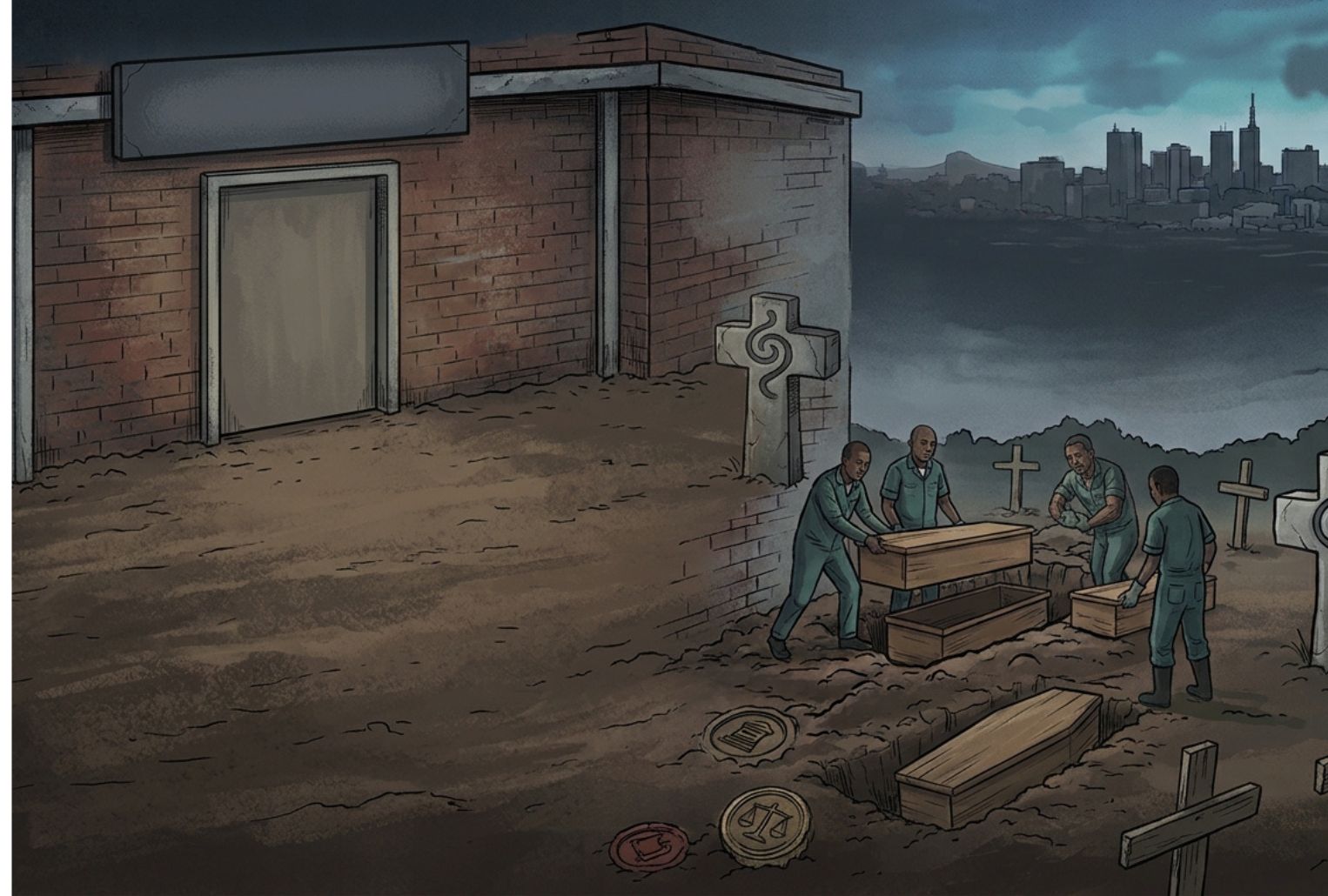
In August 2026, Nairobi City County published notices for the disposal of 473 unclaimed bodies held at the Nairobi City County Funeral Home, the facility formerly known as City Mortuary. The mortuary has a design capacity of 184 bodies. According to the county’s own official statement, these remains had accumulated between March 2025 and March 2026. Twelve months of admissions had left the facility operating at more than two-and-a-half times its intended capacity. Long-term overstayed remains, the county said, posed severe public health risks and hindered daily mortuary operations.
The county stated that it was acting in strict compliance with the Public Health Act, Cap 242, and the Public Health (Public Mortuaries) Rules of 1991. After publishing the full list in two major daily newspapers and allowing the mandatory seven-day public notice period to expire on 18 August 2026, officials announced they would move to court to seek burial orders. The process, on paper, followed the law.
Major news outlets amplified the seven-day public disposal notice on X in an effort to alert families before the deadline lapsed.
Nairobi City County has issued a seven-day notice for the public to identify and collect 473 unclaimed bodies lying at the Nairobi Funeral Home, formerly known as Nairobi City Mortuary.https://t.co/GsvXn1hJny
— TheStarKenya (@TheStarKenya) August 11, 2026
Around the same period, additional notices appeared. One covered 59 unclaimed bodies at Mama Lucy Kibaki Funeral Home, admitted between April 2025 and February 2026. Another listed bodies at Mbagathi County Hospital Funeral Home. Earlier in the year, Kenyatta National Hospital had issued its own notice concerning hundreds of unclaimed remains at its Farewell Home. Taken together, the public record from that wave of notices pointed to well over 500 unclaimed remains across just three facilities in Nairobi, with further pressure at national referral institutions.
Most of the bodies listed at the Nairobi Funeral Home were adult men. A significant proportion were recorded only as “Unknown African Male” or similar descriptors, indicating they had arrived without identification documents. The recorded circumstances of death included natural causes, sudden deaths, road accidents, suspected murder, drowning and mob justice.
What the law requires
The Public Health (Public Mortuaries) Rules, 1991, set a clear holding limit. No body should remain in a public mortuary for more than ten days. After that period, and following public notice and court authorisation, unclaimed bodies may be disposed of. Nairobi City County has previously disclosed that under the current administration it has already lawfully disposed of more than 1,000 unclaimed bodies through this process.
Official statements from the county also confirm that post-mortems are conducted under the leadership of the Chief Government Pathologist and that DNA samples are systematically collected and stored by the Government Chemist. In theory, this creates a permanent biological record that families can later use to establish identity even after burial.
Kenya also maintains a national fingerprint database through the Integrated Population Registration System. Standard operating procedures developed under the National Coroner framework, and reinforced by National Police Service standing orders, require that fingerprints be lifted from unclaimed bodies and searched against national registration records held by the National Registration Bureau.
On paper, the systems exist. The national database exists. The stated policy of DNA collection exists. The legal authority to dispose of bodies after due process exists.
The missing numbers
What does not exist in the public domain is any accounting of how those systems performed in the case of the 473 bodies.
There is no publicly available figure for how many of the 473 bodies had fingerprints successfully lifted. There is no figure for how many of those fingerprints were searched against the national database. There is no figure for how many produced a positive identification. There is no figure for how many DNA samples were properly logged in a system that families can actually access months or years later.
In August 2026, as the disposal notices were active, Governor Johnson Sakaja publicly called for the modernisation of biometric identification technology and better family-tracing systems. He urged the National Registration Bureau and the National Police Service to improve the tools used to identify deceased persons brought to public mortuaries without documents. The call itself was an acknowledgement that the existing process was falling short.
County statements at the time emphasised inter-agency collaboration with the Judiciary, the National Police Service Homicide Division, civil society organisations and the Law Society of Kenya. A dedicated family desk was established at the funeral home to provide information, counselling and tracing support. These measures were presented as evidence of diligence. Yet none of those collaborations produced public figures on the success rate of biometric identification for the bodies listed in the August 2026 notices.
Formal Access to Information requests submitted to Nairobi City County Health Services and the Directorate of Criminal Investigations seeking the specific biometric processing statistics for the 2025–2026 cohort received no response. The silence is not incidental. It is structural.
A recurring pattern
Large-scale notices for unclaimed bodies are not an anomaly in Nairobi. Similar public appeals have been issued in previous years, sometimes involving hundreds of remains at a time. The facility has repeatedly operated far beyond its design capacity of 184. In 2024 it held more than 600 bodies at one point, forcing temporary suspension of admissions of unidentified remains.
Similar warnings were documented during earlier county disposal announcements on X, underscoring how chronic backlogs repeatedly force emergency clearances.
IRUNGU HOUGHTIN: Nairobi Governor Johnson Sakaja has announced intention to dispose of 120 bodies currently lying at the Nairobi Funeral Home within seven days.https://t.co/Q0olA0YlNk
— The Standard Digital (@StandardKenya) August 24, 2024
The repeated appearance of these lists, particularly the high number of entries marked only as “unknown,” raises a structural question that the official record has so far declined to answer. If Kenya has both a national fingerprint database and a stated policy of DNA collection, why do so many bodies still reach the point of public disposal without a confirmed identity?
Overcrowding is real. A facility built for 184 bodies holding 473 creates genuine public health pressure. That pressure is the legal justification the county cites for seeking disposal orders. But capacity stress also creates incentives to move bodies through the system quickly. Without transparent data on identification rates, it is impossible for the public to know whether speed is coming at the expense of thoroughness.
By late 2026, Nairobi was seeking private investment to expand the City Mortuary into a modern facility with capacity for 1,000 bodies and an improved forensic laboratory. Such expansion addresses the physical bottleneck. It does not automatically close the identification gap. More cold storage without better biometric throughput and transparent reporting simply allows larger numbers of unidentified remains to accumulate before the next round of notices.
What the documented record shows
From the official notices, county statements and legal provisions examined over several months, a consistent picture emerges.
Four hundred and seventy-three bodies were gazetted at a facility with a capacity of 184. The remains had accumulated over a twelve-month period from March 2025 to March 2026. Additional notices covered at least 59 more bodies at Mama Lucy Kibaki Funeral Home. The county followed the formal requirements of public notice and stated its intention to seek court orders. DNA collection is presented as standard practice. The Governor publicly recognised the need for improved biometric systems. No public data has been released on the actual fingerprint or DNA identification rates for this cohort. Formal requests for those figures went unanswered.
This investigation is based entirely on publicly available official records. It does not rely on anonymous sources or physical visits to mortuaries. The silence around the biometric numbers is therefore not an absence of information in the story. It is one of the central findings.
Kenya has the legal framework, the national database and the stated forensic protocols. What remains unproven, at least in the public record, is how consistently those tools are applied before hundreds of bodies are permanently buried as unclaimed.
Until the institutions responsible for fingerprint and DNA processing — the National Registration Bureau, the National Police Service, the Government Chemist and Nairobi City County Health Services — publish clear statistics, the gap between the systems that exist on paper and the hundreds of unidentified remains that continue to appear in county notices will remain one of the least examined failures in Nairobi’s public identification infrastructure.
The bodies are gone. The questions remain.