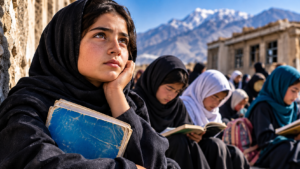








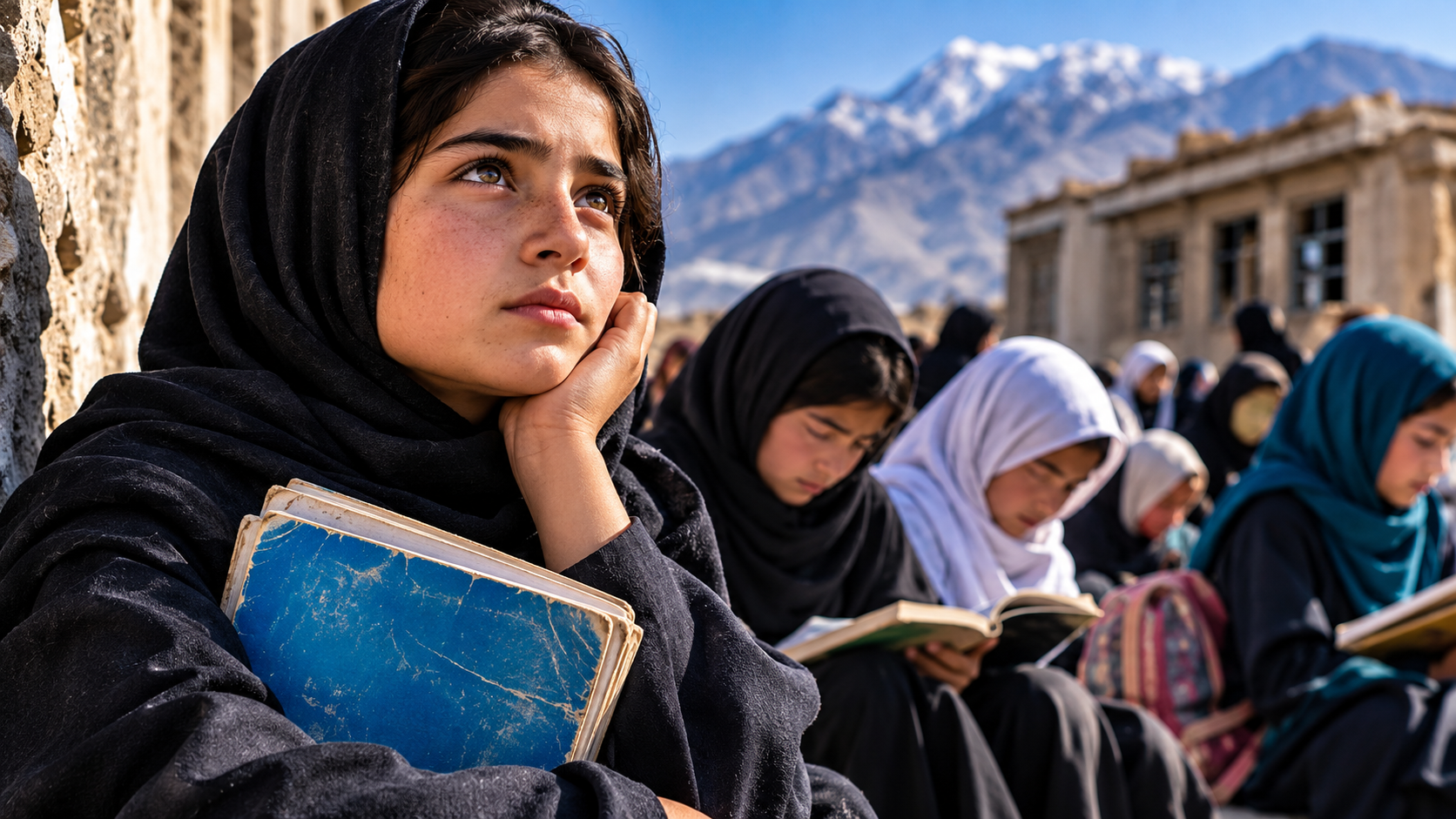

Thousands of girls in Afghanistan are spending their days at home, waiting for a future they once expected would be shaped by education. Before restrictions were imposed, many planned to continue their studies, attend university, and pursue independent careers. Today, countless girls remain excluded from formal education after completing the sixth grade, leaving their aspirations on hold.
According to the United Nations Children’s Fund (UNICEF), more than 2.6 million girls in Afghanistan have been deprived of secondary education since 2021 because of restrictions preventing girls from studying beyond the sixth grade. More than five years later, Afghanistan remains the only country in the world where girls and women are barred from secondary and higher education.
For many girls, home has become more than a place of residence. It has become a place of waiting, where schoolbooks are preserved as reminders of interrupted ambitions.
Years of Waiting
Sixteen-year-old Palwasha (a pseudonym) says she never imagined that completing sixth grade would mark the end of her formal education.
“When schools were closed, we thought they would reopen after a few months. But months and years passed. I still keep my books. Sometimes I take them out and read them, but they cannot replace school or a teacher.”
Before the restrictions, Palwasha dreamed of attending university and pursuing a professional career. Today, she spends her time at home, uncertain when or whether she will be able to continue her studies.
For girls like her, the consequences extend beyond the loss of a few academic years. Long-term absence from education can weaken learning skills, reduce future opportunities, and make returning to formal schooling increasingly difficult.
UNICEF reported that in 2024 more than 2.13 million school-aged children in Afghanistan were out of school, nearly 60 per cent of them girls.
Falling Behind
Another student, Zainab, says her greatest concern is the growing gap between herself and her peers.
“When I see my friends studying and talking about university, I feel that I have fallen behind them. I still want to study, but I don’t know when I will get that opportunity.”
Many girls continue searching for ways to preserve their education despite the restrictions. Some read independently, while others attempt to use online learning platforms and informal educational programmes.
However, access remains unequal. Poor internet connectivity, electricity shortages, limited access to devices and the cost of courses prevent many from participating consistently.
Fifteen-year-old Fatima (a pseudonym) explains:
“I try to study at home. I read books and sometimes find lessons on the internet, but when there is no electricity for several hours or the internet connection is weak, I cannot study properly.”
Learning Beyond the Classroom
UNICEF has identified community-based education programmes and alternative learning opportunities as important measures to support children who remain out of school.
In 2025, approximately 442,000 children participated in community-based education programmes, with girls accounting for 66 per cent of those enrolled.
Fatima, who has spent several years outside the formal education system, says she continues to study whenever possible.
“I don’t want to feel, a few years from now, that I have forgotten everything. Every day, I try to learn something, whether it is English, computer skills or reading books. But it is different from going to school.”
Beyond academic lessons, she says she misses the interaction with teachers and classmates that once formed an important part of daily life.
Wider Consequences
The impact of educational restrictions extends far beyond individual students.
UNICEF has warned that continued exclusion of girls from education could create significant shortages of female professionals in Afghanistan in the coming years, particularly in sectors such as education and healthcare.
According to UNICEF projections, Afghanistan could lose approximately 20,000 female teachers and 5,400 female healthcare workers by 2030 if the restrictions remain in place.
The number of women teaching in primary schools has already declined, from roughly 73,000 in 2022 to around 66,000 in 2024.
Families Watching Dreams Fade
For many parents, concerns extend beyond the present.
Gulmina, a mother whose daughter hopes to become a doctor, fears the long-term consequences of prolonged exclusion from education.
“My daughter wants to become a doctor. I don’t know how she will achieve her dream if she remains away from education for several years. We want her to study and build her own future.”
For families across Afghanistan, every missed school year represents more than the passage of time. It is a lost opportunity to learn, develop skills, prepare for higher education and build a future career.
Hope Despite Uncertainty
In August 2026, UNICEF reiterated that more than 2.6 million girls had been deprived of secondary education and warned that exclusion from school can increase vulnerability to child marriage, exploitation and gender-based violence.
Yet despite these challenges, many girls continue to study whenever possible. Some learn independently at home, some attend informal educational programmes, and others participate in reading groups or online courses.
Their shared wish remains remarkably simple: to return to the classroom, learn alongside their peers, and continue the educational journey they were forced to leave behind.
As Maryam puts it:
“I still want to study. I still have hope for my future. I just don’t want to spend many more years waiting.”